Thoughts on ... The Lost Children Chapter
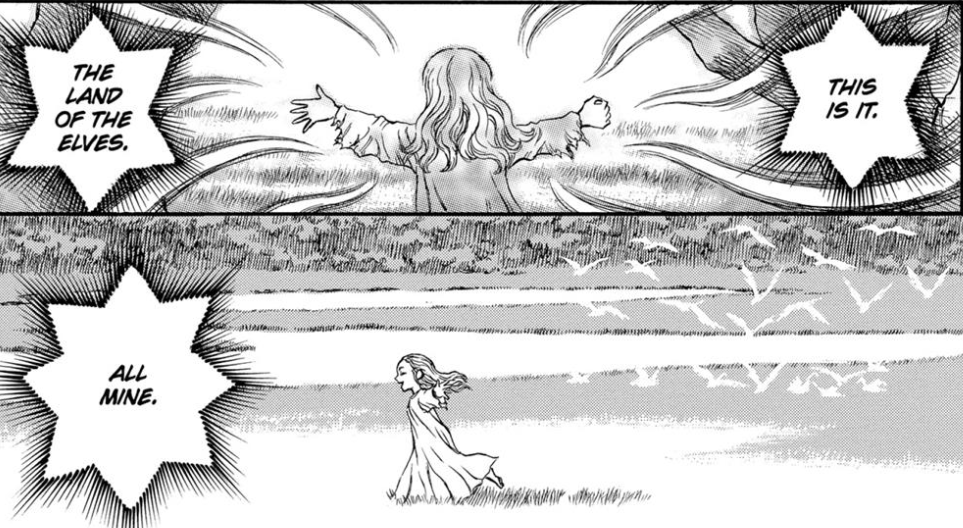
girl, it doesn’t exist.
It’s been a while since I’ve written about Berserk, but it’s remained close to my heart over the past few months. Chapter 359 was released in the summer, and there was so much to unpack. I was desperate for the next installment, and so far it hasn’t come. Berserk fans across the twittersphere have been apoplectic with desire, leading to funny threads and very thirsty AU head-canons that I’ve shamelessly participated in. It’s just one of those series, that even during crippling hiatus, you can’t get too enraged at Miura, so delirium and desire is all you can succumb to. During the wait, I’ve taken to buying the special edition hardbacks and re-reading the series, combing over my favourite moments. I’ve gone back over Conviction, looking closely at a specific mini-arc and recalling my horror when I first read it.
Whenever fans recommend Berserk, besides incomprehensible but totally justified anti-Griffith rhetoric, incomprehensible but totally justified Judeau fan-girling, and incomprehensible but totally justified Skull Knight lust, warnings about Lost Children inevitably surface. It regularly appears as a fan favourite to the point of it being (wrongly) separated as its own arc, and not a detour within Conviction. It is a perfect story, so beautifully contained, so it’s hard to blame people if they choose to pay it particular homage. But it is a vital element of Conviction in general and plays an important part to Guts’s character development later on in the arc. But why the warnings? It features a concentrated violence not seen since the Eclipse ceremony; child abuse, child murder, rape, domestic violence, and gore all feature in twenty-three episodes, and this is just the start of the Conviction arc. Here’s how to tell if someone is in the know: whisper “adult attack” in their ears, and if they recoil and give you the sign of the cross, then you know that they know. Hereby is the new secret password for all Berserk fans.
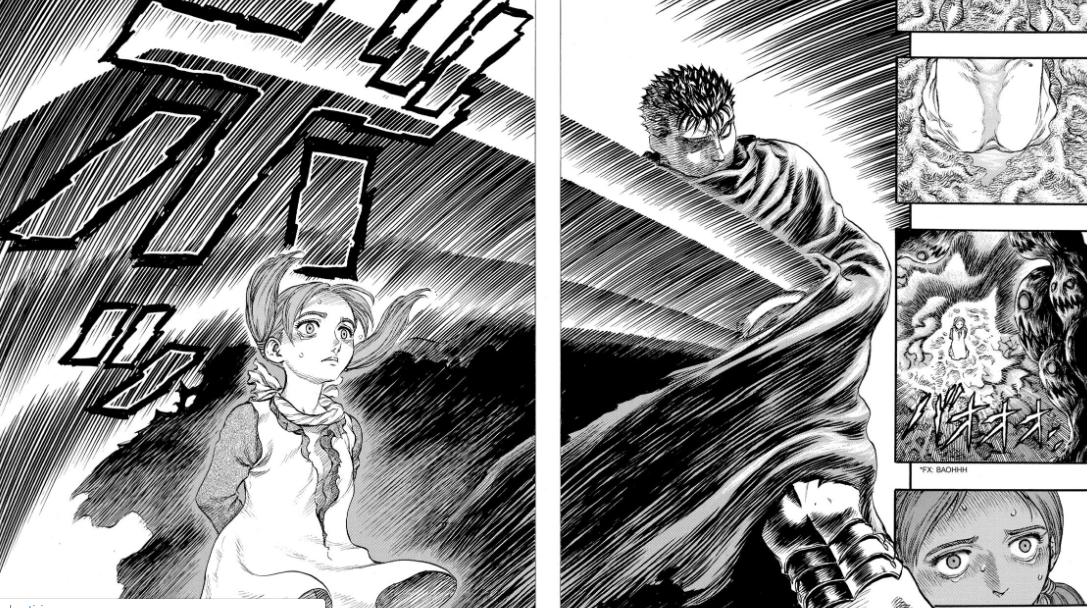
Is this not the coolest double page ever?
Timeline-wise, it continues from where Black Swordsman left off. Guts is a solitary mercenary now, trying to locate Griffith after the big betrayal. He’s got an innocent companion, Puck the elf, and travels to a decrepit village populated by poor and dishevelled people who, by their claim, have been subjected to terror by some dangerous elves in the nearby Misty Valley. Guts’s brand-sense tells him that the elves are the work an an apostle, and with a local child, Jill, he ventures into Misty Valley himself, coming across Rosine, a troubled girl who made a pact with the God Hand to become an apostle, the Queen of the Elves. As it happens, she’s also Jill’s childhood friend who disappeared under mysterious circumstances years prior. Rosine has been taking the village children under her alluring wings, re-birthing them into smaller apostle-elves, and wrecking havoc to her former home. As Lost Children progresses, we uncover the reasons why Rosine chose her current path, and explore Jill’s own inner demons, the lives of the villagers, and Guts’s constant struggle against the darkness within and outside himself.
At the start of the arc, Guts has been perilously alone, travelling beneath the ominous cloak of the Black Swordsman on a futile quest for revenge. His relationship with Puck is almost abusive and hostile, despite the elf’s charming persistence. Arriving at the desolate village, he finds himself a pariah again as the villagers openly antagonise him for travelling with… an elf, but they are not to know that Puck is a genuine, harmless creature, as up to this point, all their dealings with elves have involved child kidnap, crop decay, and the mutilation of their animals. When Guts chances upon Jill, subsequently kidnapping her to ward away the villagers (ever the diplomat), he soon discovers that despite their fear, there is a deeper running hostility that perhaps makes them an easy target for a wayward apostle. For example, Jill’s parents don’t come to her rescue when Guts whisks her away, and her pitiful drunken father only emphasises that there is more to Jill’s story than Guts realises. Her own despondent, slightly disgusted response to her father’s cowardice can only make the reader cringe with second-hand embarrassment.
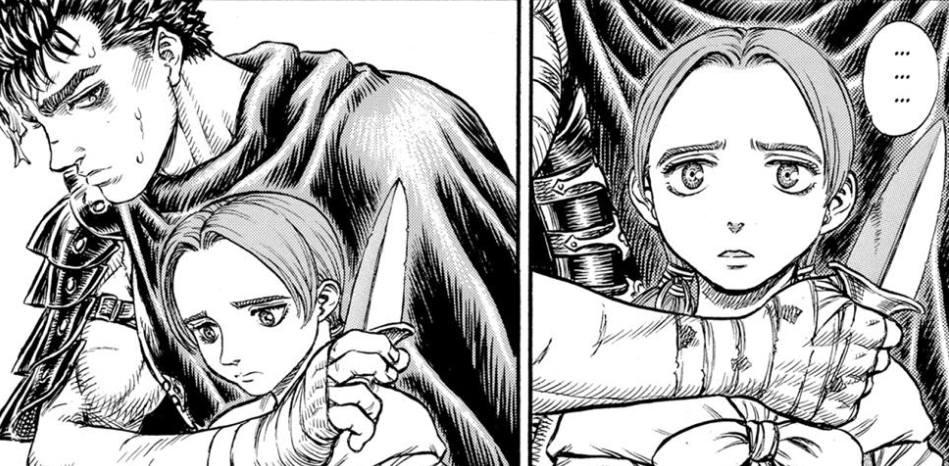
if your child looks at you like this, you’ve done everything wrong.
The use of a child deuteragonist nicely reflects an earlier instance in the story when Guts interacted with Theresia. Already done with life and supposedly devoid of empathy, the pair’s interactions are volatile and dark. Guts mercilessly kills her father, the Count, because he is now an apostle and busy destroying people’s lives as apostles are wont to do. After his brutal expatriation to the void, Theresia throws the ordeal at Guts’s feet, blaming him for the death of her father and all the troubles her town has faced since his arrival. Guts is equally hostile to her, advising her to commit suicide if it’s all so upsetting. Before the chapter closes, Guts’s face is a mask of distress.
risky Google search of the day.
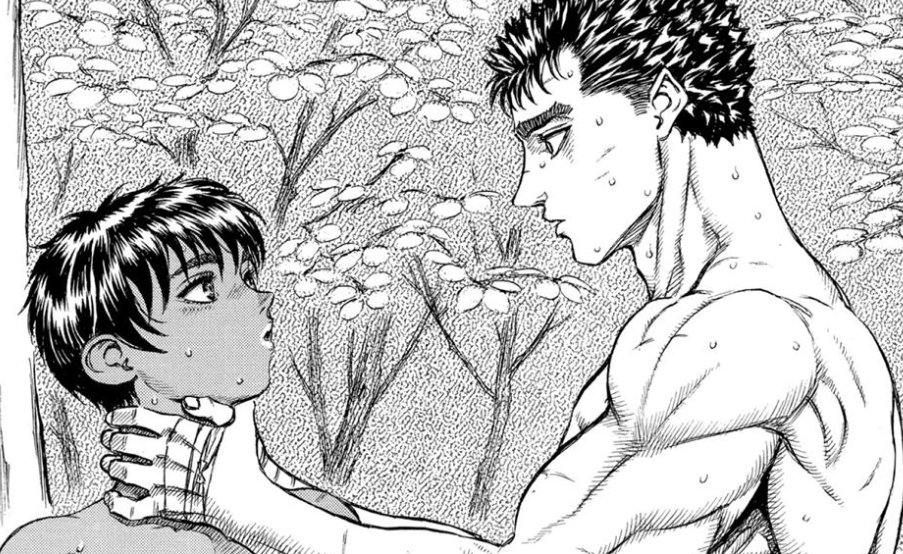
Only when reading the Golden Age does the reader understand some possible reasons as to Guts’s sad change of heart: a survivor of child abuse, he too suffered the betrayal of adults around him, and was forced to see the darkness of a world he was still too young to understand. His childhood scars remain an unwanted presence, affecting his interactions with his fellow mercenaries into adulthood. Like Theresia, he met the God Hand and survived, only to disastrous results. He tried and failed to maintain a stoic and cruel facade with Theresia, almost as if trying to expunge himself of his weakened, childhood body. Interestingly, when Guts suffers a flashback during his time with Casca, his first reaction is to reach out and strangle what he believes is his childhood self. His response to pain is often violence, and as he admits to Casca, he was weak and defenceless when Donovan raped him. The admittance almost seems to disgust him. After confronting his past demons, he descends into despair, only, unlike with Casca, there is no one in the Count’s lair to comfort him.
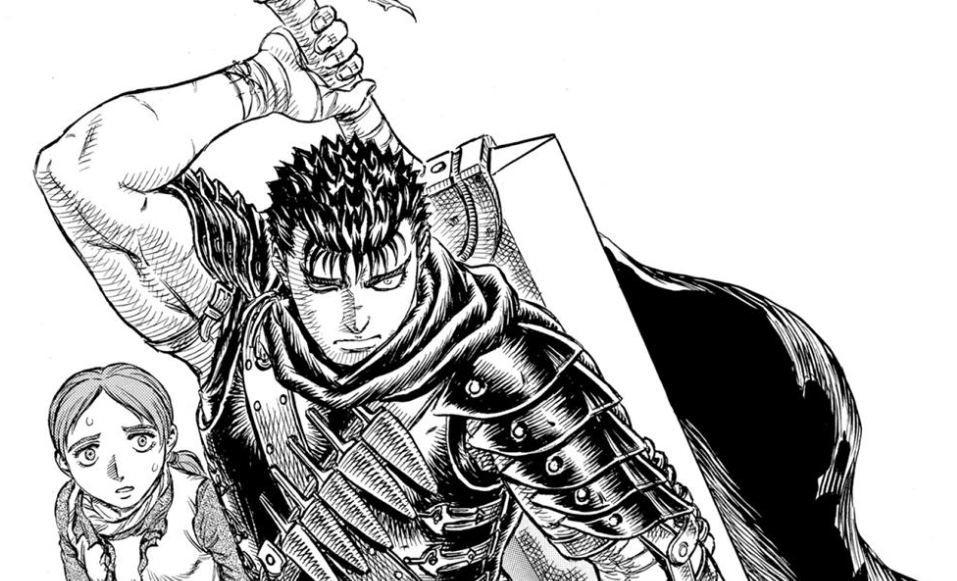
someone defend me like this pls
Enter unlikely Jill. Another dependent child, she is forced to mature above her age, suffering from both physical and sexual abuse from her father and his friends respectively. Although not exactly warm to her at first, when Guts sees the bruises on her arm, his coldness dissipates. Somehow, despite Guts’s menacing appearance, Jill never recoils from him, going as far as to sleep alongside him in the abandoned windmill in what appears to be the first restful sleep they’ve both had in a long while. Perhaps Jill can sense a deeper brokenness within him? There’s also Puck, of course, which provides a foil to his otherwise steely exterior.
When the pair finally confronts Rosine and her army of elves, Guts is burdened with another tale of childhood horror. Rosine and Jill share a similar history of abuse, but unlike Jill, the former eloped to the fantasy world in her head, leading her to the abandoned Misty Valley which she genuinely believed housed an elfen commune. After finding the forest desolate, she created it herself by sacrificing her parents to the God Hand. Rosine’s world is supposedly a safe haven for the children of the village, all of whom have experienced some hardship, based on their supposed willingness to be turned into elves at Rosine’s suggestion.
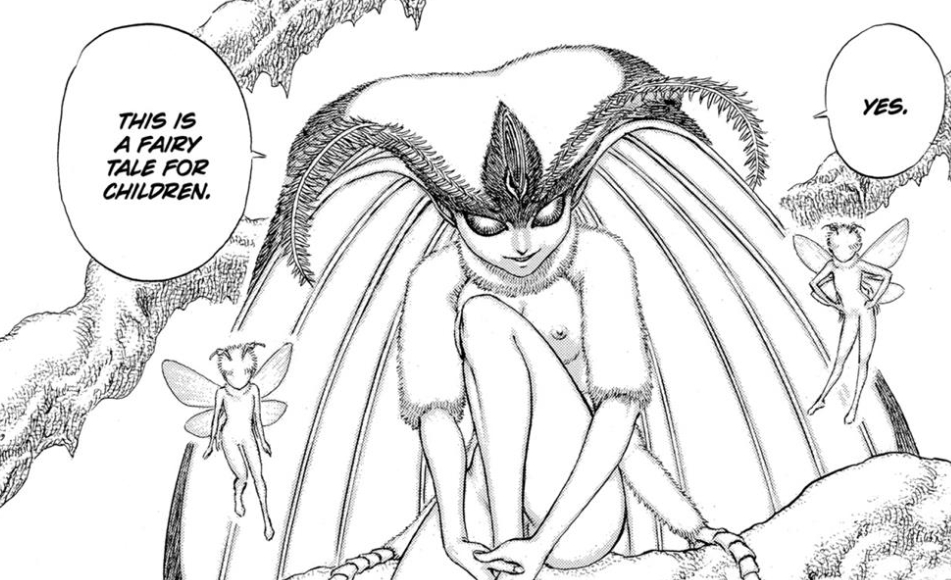
erm… no thanks.
In the Misty Valley, they can escape from the poverty, the domestic violence, and the pitiful display of the drunken former soldiers who clumsily rule their village. The child-elves like to play “war games”, where they violently attack each other to the death. Literally. After war comes plunder, for which the kids yell “adult attack!” and sodomise each other with the sharp stingers attributed to their elfish bodies. This is what they have been exposed to: in their world, this is normal adult behaviour. Their view of adulthood is framed by rape, murder, and violence. When Jill challenges these behaviours, Rosine is sympathetic to her friend’s obvious discomfort, but that is where her sympathy stops: who would want to return to the village, where everything was worse for them? And, if adults can do these things, why can’t children?
The ultimate fight between Guts and Rosine proves difficult for a myriad of reasons. For one, Jill is an ever-present distraction, but also is Guts’s own reservation. He is provided with ample opportunity to kill Rosine, but his strike misses more than once—he eventually muses that his hesitation is because Rosine is a child. He forces himself to attack her, delving deeper into the darkness of himself; if he caves to sympathy, the God Hand—Griffith—wins. It gets gory and brutal: Guts risks setting himself on fire, bursting the birthing pods of soon-to-be-elves to extinguish the flame, and their half-formed, gunky bodies fall onto his shoulders in thick, bloody globs. Several times during the fight, both Jill and Puck find it difficult to distinguish the demon from the victim, but Guts has to face her. He has to come to terms with his childhood ghosts.
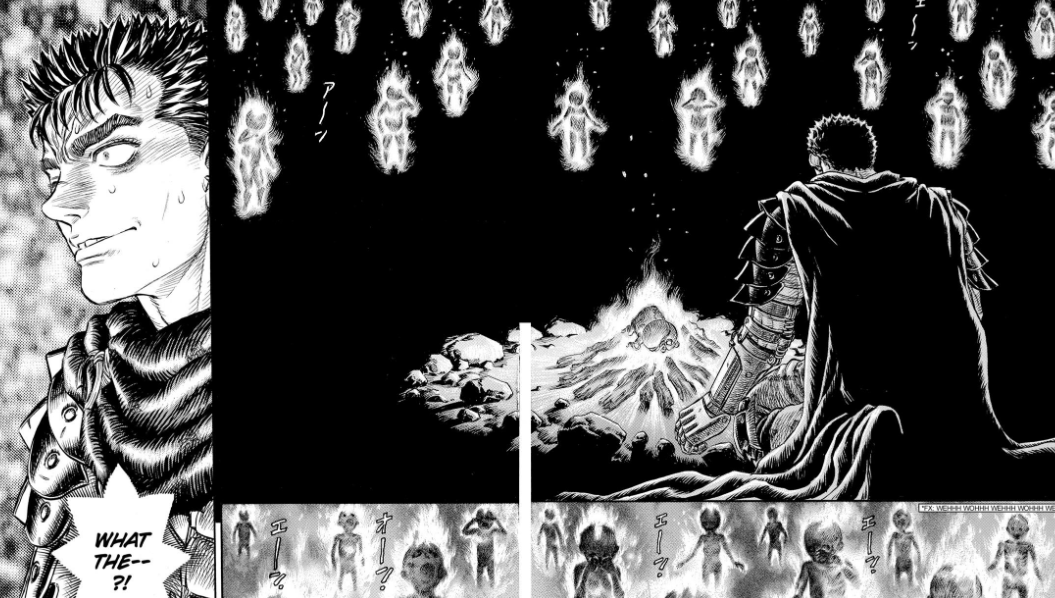
one of his hardest battles, surely
In the foreground of this battle is of course Guts’s own deformed foetus, his child that never was. Earlier on, Guts is tormented by fiery childlike apparitions that he is forced to slaughter, and in the midst of the flame is the same feotus he was driven to abandon to the sunlight after Casca’s labour. He is constantly tormented with broken childhood; from his own, to this group of battered children, to his child. If the world had been less cruel, Guts could have done the right thing with his own child had it survived. He could have challenged the injustices he faced by loving and caring for his own offspring with the only woman he ever loved and allowed into his personal, sensitive space. As he looked on the mottled bodies in Rosine’s birthing pods, his own lost child must have interrupted his thoughts.
At the end of the fight, Rosine takes one final flight towards the moon, still trying to search for the true elves that never came. Puck reveals himself, offering a final mercy to a childhood dream that is rapidly slipping away with her consciousness. Sometimes I wonder, if Guts had met Rosine and Jill at another point in the story, would he have been able to take them on his journey? They both would have found the elves on Skellig Island, and would have come to a much more peaceful conclusion.
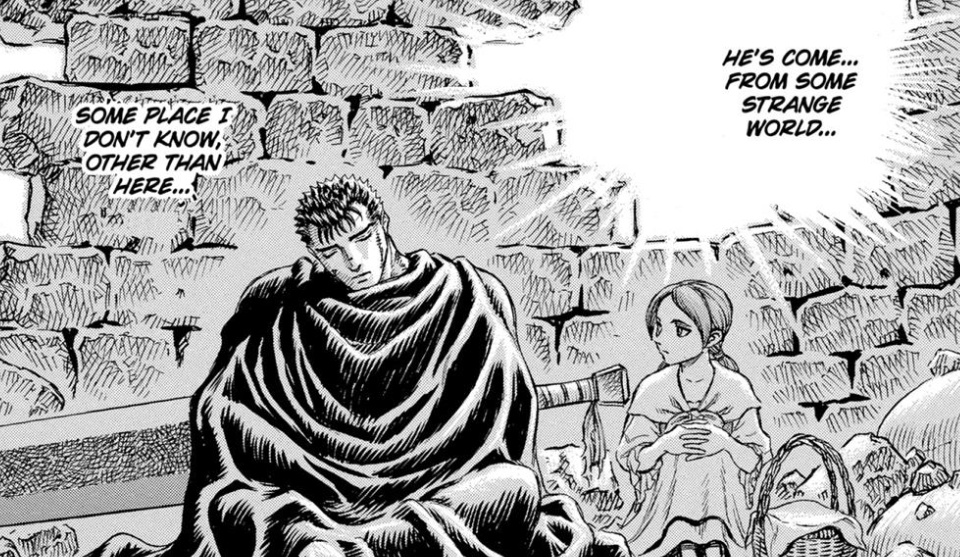
sweet girl. she even brought snacks.
Jill and Rosine provide two responses to trauma. Rosine wanted to escape to her own fantasy land to the bitter end. Rather than stay and face her turmoil, she makes her dream a reality, regardless of the cost. Unlike the other village kids, she is unable to persuade Jill to stay at Misty Valley because Jill does not believe that fantasy worlds will help her. She objectively observes the adult games and the antics of the elves as symptomatic of the village’s influence, and if that influence is what birthed the Misty Valley fantasy, can it really be a conducive means to cope with and heal from abuse?
Her answer is found in Guts. When she begs him to take her with him on his journey, he asserts that there is no magical place to escape to. The same force that corrupted Rosine follows him everyday—but that’s the cross he has to bear if he wants to progress. She has her own burdens back home; the only way for her to grow is if she faces them properly and fights against them. The Misty Valley is only a dream. Their parting is a stark contrast to Theresia’s; Guts comes to an understanding with Jill. He knows that they are both cut from the same cloth, dealt bad hands, and have been collateral damage in a constant, cosmic battle that they had no choice over. He leaves the village with a reforged friendship with Puck, finally acknowledging the physical and emotional benefits of his presence. You could argue that the encounter with Jill and the village enabled Guts to form close brotherly relationships with Schierke and Isidro, offering guidance and assuaging their personal insecurities and troubles at various points in the story.

silly puck!
It’s hard to see Rosine as your typical apostle: her motives are easily empathised with, and she responds to her trauma in a way that is fitting for her age. Guts had to muster both mental and physical fortitude to fight her because in a way, he was confronting a part of himself, and the unjust world that creates demons like Rosine in the first place. Jill provides a healthy medium between the two: she can easily see that many of Rosine’s actions have been abhorrent, but she lived in Rosine’s shoes. She knows how far the village can drive a person to madness, so it can be easy to see some of Guts’s actions as disproportionate to her crimes.
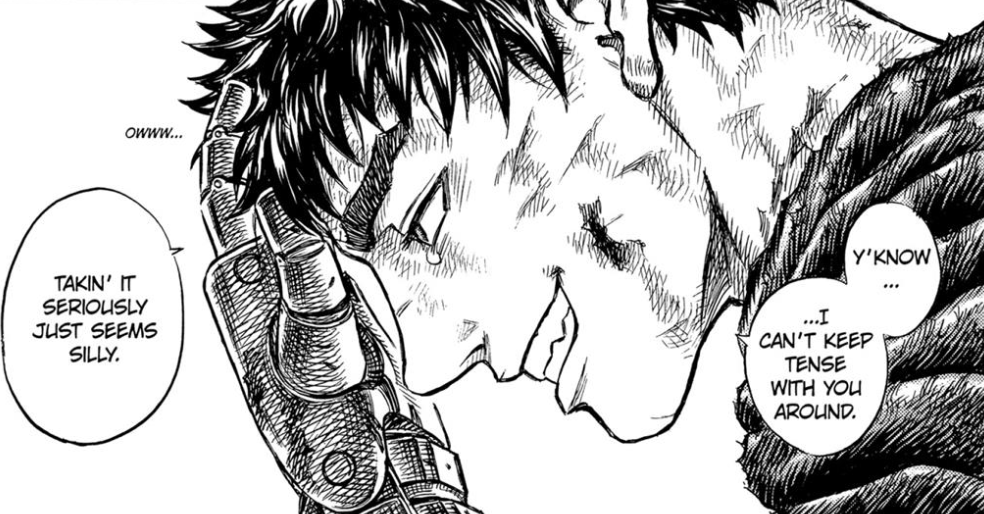
silly guts!!!
I would love to revisit Jill in the same way Luca and crew returned to the story; her role is so vital to Guts’s growth as a character, and seeing her bravely return home to show her father her newfound confidence is so inspiring. Guts was kind to tell her that he’ll be fighting his own battle with her. He offers honesty: life might not improve the way you want it to, even if it’s been shit already, but it doesn’t necessarily make you powerless to its whims. The ability to persevere amidst adversity is an improvement in itself, and when the good moments arise, make sure you take hold of them violently, relish them aggressively. Jill’s small giggle with Puck at the end, gifted with his special medicine, indicates her resolve to create a happier space for herself, despite the turmoil around her.
Guts’s experience with Jill laid the groundwork for the his further character progression in Conviction. Thanks to what they both endured in these chapters, he is able to form stronger bonds with others.
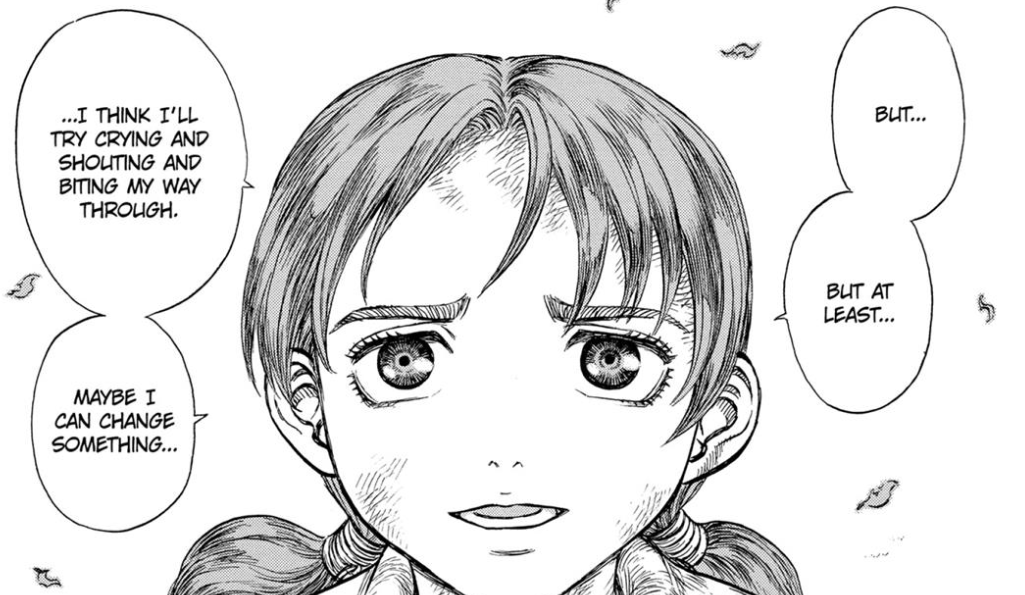
atta girl, Jill!