Casca, Revisited: Rape, Plot Devices, and Character Development
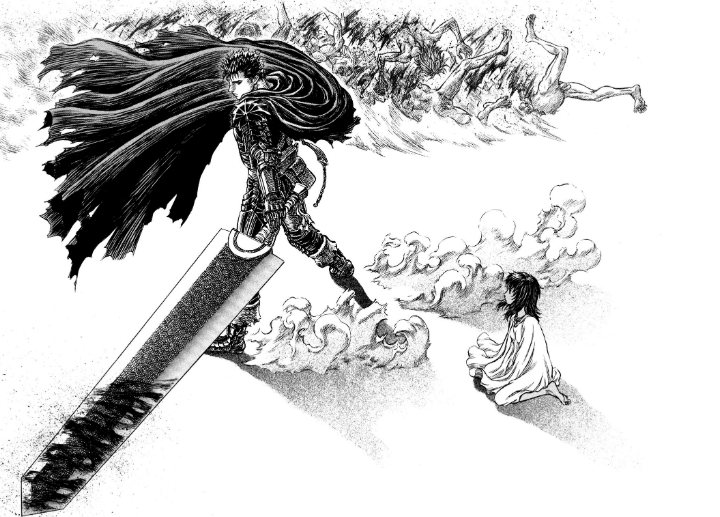
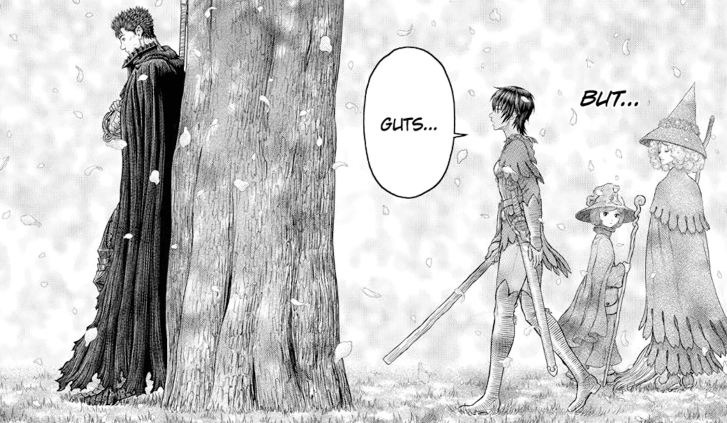
Just putting this here because I love the panel so much. This is taken from “Reunion”, episode 148.
Two years ago, I wrote about Casca and her discomforting depiction in my favourite manga series, Berserk. The article was written out of frustration, because there was very little—or very shallow—discussion on her and the way she’s been treated over the years, and oftentimes Berserk superfans totally deny that the depiction of rape in the series is distasteful without succumbing to SJW slander. My main objective was to outline just how many times rape appears in the series, because over time it can be easy to forget and to accuse people who have a problem with it as being overly sensitive and blowing things out of proportion. I was also venting, so at the time my thoughts were muddled. This is all to say that I don’t think I conveyed my feelings as coherently as I would have liked and I’ve planned to revisit the article for the longest time. So, here we are, discussing rape in the first month of the new year.
I like Casca because she epitomises strength. I recently binged The Witcher on Netflix and stared open-mouthed at Yennefer and Geralt battling some lowly dragon thieves side-by-side, clashing swords, backing each other, with Yennefer saving Geralt to deal the finishing blow in episode six. I watched it wistfully, reminiscing on Casca and Guts and the hundred men, and the conversation that Guts has with Judeau before he leaves the Band of the Hawk, admiring Casca’s ability to fight beside him.
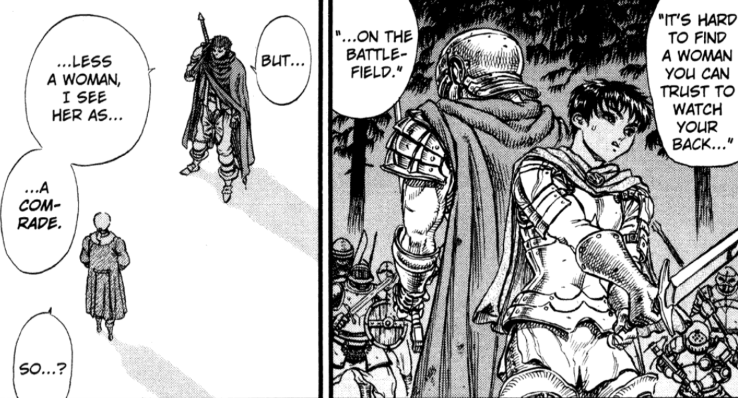
Guts and Judeau talk about Casca, Episode 34
I love her design, her skin tone, her fighting prowess, how she wears her heart on her sleeve when it comes to love, but in battle and crisis she is clear headed and measured (i.e. when the Eclipse started, she quickly mobilised the troops and calmed everyone’s panic). She provides an alternative response to the Eclipse: whereas Guts descended into cold, cruel violence, Casca lost herself in another way. I don’t think this means that Casca is emotionally weaker than Guts—she’s just a different person, responding differently. The “brooding angst-ridden soldier on the quest for revenge” is an unoriginal trope to be honest, so I don’t mind that Casca lost her senses; at least it provided something different. In a way, Broken Casca embodies the turmoil in Guts’s head and heart, which he covers up by slicing and dicing and not giving a shit about anyone until Godo drags him out of his darkness and sets him straight again. His mission to save Casca then introduces some noble altruism to his quest, and he changes his goal to save them both from the wounds of their past. I love the narrative switch, but I want to discuss this further in another post, so will leave it alone for now.
Whilst Casca breaks gendered stereotypes in some ways, the merits of her portrayal suffer under a more critical lense. For a lot of male writers in particular, rape is the go-to method to show how evil an antagonist is. The usual defence for this trope is that the author needs to give some medieval realism to a medieval-inspired story. For these people, inclusion of excessive rape is enough for them to feel immersed in the time setting, even with a story of dragons, demons, witches and oracles—which are not of our world, violent misogyny from our world, however, is an absolute must if the author wants to retain any sense of realism. Last year I breezed through A Song of Ice and Fire and I was equally annoyed that, despite creating his own world that he could literally do anything with, George RR Martin reinforced gendered violence (rape and more rape), racism (dark skinned characters are subjected to slurs by the white ones), and ablesism (everyone hates the “imp”, even in make-believe Westeros). It’s not as skilful as people would like to think, and shows some limitations in the author’s storytelling.
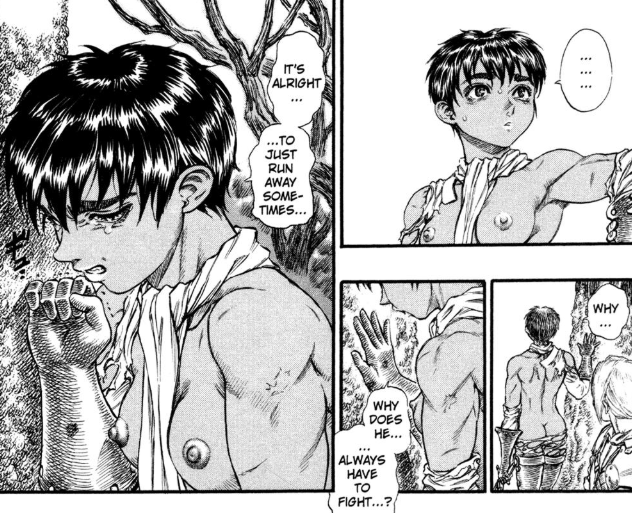
She’s saying some important stuff here but I’m TOO DISTRACTED. Judeau, please get her a shirt.
Casca gets raped. A lot. If not full rape, then she suffers many attempts. There is a flashback of her almost-rape as a child. During the fight with Adon, she’s almost raped by a gang of his soldiers. She gets her clothes ripped off and almost-raped again by Wyald, and she then spends the rest of the chapter half naked, breasts a-bouncing, in a crowd of fully clothed mercenaries. She is raped to insanity by Griffith, a rape that goes on for too long, accompanied by questionable angles and positions that are not only unnecessary, but grossly exploitative in its obvious attempts at titillation. After escaping several unclothing attempts during her time as Elaine, Casca, now with Guts, is raped by a random group of nameless men after she wanders off on her own. Guts arrives too late, staring in horror at her bloody crotch and the bloodied men that she slayed in the aftermath. Filled with a potent concoction of emotions that I won’t attempt to belittle here, Guts succumbs to the rage he tried to quieten, and then attempts to rape Casca himself. It’s a mess.
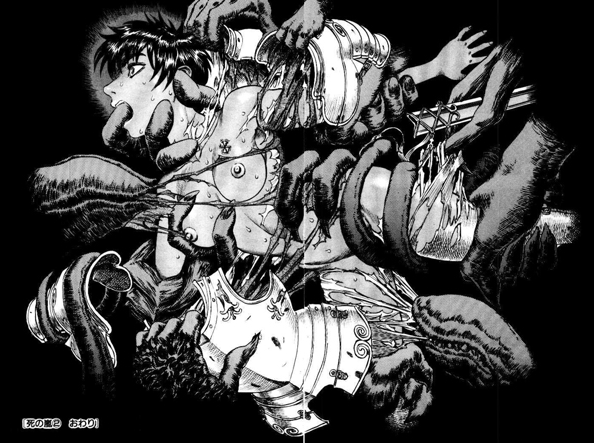
This is the only Eclipse panel I’ll share here.
The image above is taken from the very beginning of Casca’s ordeal, when the surrounding apostles shred her clothes and carry her to Griffith in episode 85. The rape doesn’t end until episode 87, meaning that we are treated to a very visual, two-chapter rape scene. Above, we have the torn shirt exposing the breasts, while a tentacle monster forces itself into her mouth and wraps itself around her body and between her legs. Tentacle porn is a real thing, and tentacle monsters are prevalent in anime and manga for fanservice purposes. We do not see any other tentacled demons wrapping themselves around any other members of the Hawk during the Eclipse. It solely happens to the only woman in the group. If you still need convincing of the inappropriateness of using a tentacle monster to commence the sexual assault, simply google “tentacle monster anime”, and you’ll see replicas of this Eclipse scene, hundreds of them. I tried to find some “tame” screencaps to give a visual comparison, but they’re all more explicit than what I’m comfortable with sharing here.
Casca’s a well developed character: she starts as a naive, somewhat annoying (love?) rival of Guts. Her entire mercenary career is defined by her desire to please Griffith, a sentiment that Judeau later identifies as an unhealthy worship of him. As she grows up a little, she starts to admire Guts, explicitly shown during the 100-man battle. Her lingering look at Guts’s retreating form through the snow in episode 33 is the clearest indication that her heart no longer has room for just Griffith. When Casca and Guts reunite on the cliff after Griffith’s imprisonment, her internal monologue is filled with confusion as she finally acknowledges that her previous devotion to Griffith was unhealthy, and that, during their year apart, her mind dwelt on Guts for longer than she was comfortable with, constantly replaying the moment of his departure in her mind. When they retrieve Griffith, she is conflicted, still trying to divest from her old feelings, and also coming to terms with Charlotte’s confession as to the reasons for his imprisonment. She grows so much, learning a lot about herself, and although she planned to stay and maintain the Band of the Hawk with Griffith, I’m sure she would have continued to transform as the commander, finding new ways to repair their fallen reputation.
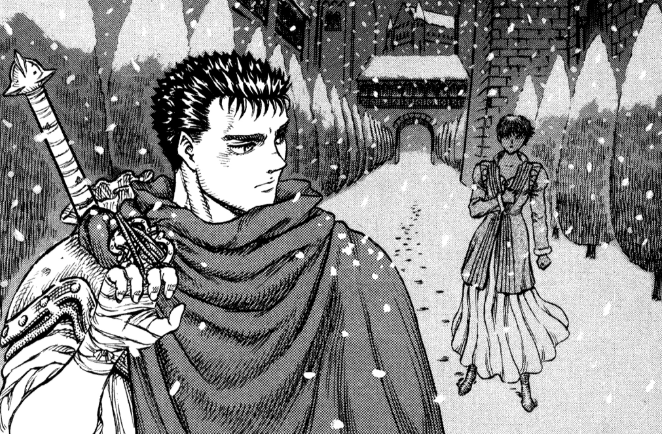
Casca tries to stop Guts from leaving… in Episode 33: “A Snowy Evening”
Casca’s journey hits a roadblock with the Eclipse. We can only imagine what she could have been had the rape never happened, which I suppose is one of the many tragedies of the story. A bigger tragedy is the duration of her brokenness. While Guts undergoes his own transformation, Casca stays the same, trapped in Griffith’s shadow. The Eclipse, episode 87, is the last time Casca speaks until episode 355. That is a long time for a deuteragonist to suffer. It’s painful to see her as this constant reminder of what Griffith has done, and I never expected her to stay voiceless for so long when I read the story the first time. It certainly makes her awakening chapter emotional for readers, and I still remember the reactions from long-time fans when it happened, but I think some more moments of Casca and Farnese together bonding, having some kind of unique conversations, would have given Casca more personality, and showed us a part of her mind that we wouldn’t have seen before. I’ll be honest: when she told Farnese and Schierke that she remembers her time with them, it was hard for me to believe, as she gave little indication that she knew anything was going on during that period at all. If Miura wanted to explore mental health and PTSD with greater depth, I’m sure he could have given us more reflective moments with Casca, showing her processing—or revisiting—the Eclipse even in her muddled state.
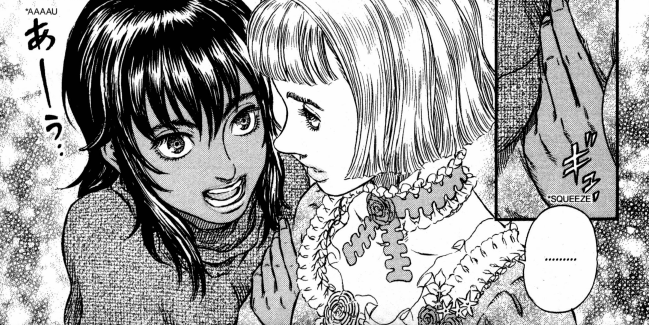
Yes, yes they’re both sweet together, but I do think this was a lost opportunity. Farnese grew; Casca froze in this state.
Over time I’ve seen newer readers bemoan Casca as a pointless plot device. I disagree wholeheartedly, and I think an assessment like that comes from a reader without discernment. Her best moments truly were during the Golden Age, and her silent, broken state is a disappointment, but the potential for her character is what drives the story forward. Every arc post-Golden Age has Casca at its centre: Conviction is about her retrieval, and Guts’s resolve to abandon his revenge quest and do right by her; Falcon of the Millennium is about the journey to find her cure, and Fantasia is focused on her awakening and recovery. Now that she’s back, fighting golems and training Isidro al-fucking-ready, there’s no limit to what she’ll add to the travelling party and I’m so excited for it.
In all honesty, I think male writers in particular should try to find ways to explore female struggles in a man’s world without relying on gritty “realistic rape”, especially in a fantasy setting when you can make men be anything you want, with a whole different sexual system and an entirely different way of asserting their dominance that is alien to us in the real world. Because it’s a fantasy story. If Berserk was written by a woman, it would have been lambasted as some “misandrist” story with a feminist agenda.
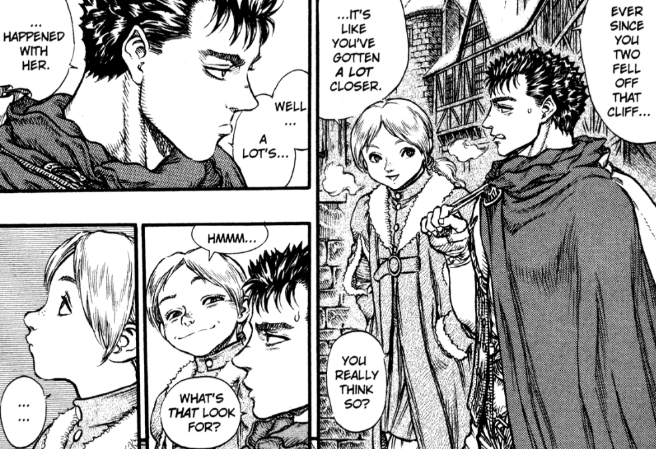
Judeau, you troll. From Episode 34: “Morning of Departure”
This is not to say that I think rape should be absent at all—it has its place because like it or not, it happens. My issue with Berserk is its regularity and the gratuitous way it is drawn sometimes. Guts’s abuse at the hands of Donovan, and Casca’s abuse at the hands of the noble, are both poignant and harrowing scenes because it allows the reader to fill in the obvious gaps that Miura has left in the artwork for that purpose. The abuse of women in the Tower of Conviction is equally well-done for the same reason: we are shown enough and it is gruesome, without appearing exploitative and solely for shock factor. There are other instances, but these are the moments that stand out to me.
I’ll return to A Song of Ice and Fire because, for all its pitfalls, Martin certainly knows how to write women with varying experiences. Brienne of Tarth reminds me of Casca in many ways. If Brienne had been dismembered like Jaime, it would have provided a devastating blow to her as a person because she is such a gifted swordsman—the tragedy holds weight because her character has been established brilliantly. Casca could have been given a physical ailment that spoke of her fighting ability, not just her femaleness, because Miura has already shown us enough of her skill and her honour as a soldier. It doesn’t have to be sexual assault. There are other options of conflict for her.
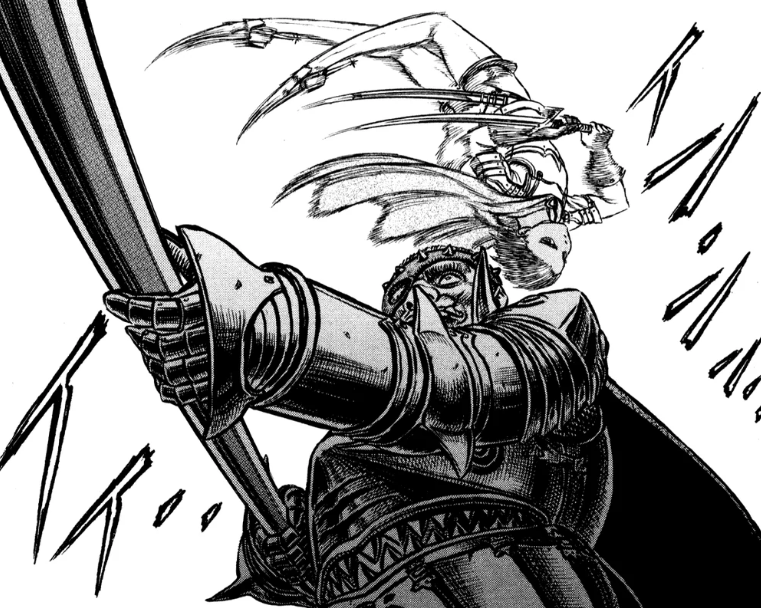
FUCKING BADASS. From Episode 27: “Battle to Capture Doldrey (5)”
Likewise, Arya, Asha, and Catelyn all struggled in different ways: bereavement, a quest to assert dominance, and trying to guide a naive son through war, embattled these women respectively. Casca’s brokenness is of course a struggle outside of rape, but without some dialogue and meaningful interaction with her, it merges into another one of Guts’s struggles because we don’t get to see how it makes her feel to be in that state. As an aside, the subject of the moonlight child is a saving grace for her character, as it shows that she, more than Guts, understands what he is, and she was the one who felt the essence of their child in Griffith’s body, whereas Guts was too angry and confused to get it. This might allude to a sixth-sense that Casca has developed as a result of her branded state—a power that could play a bigger role in the story now that she’s awakened.
Thankfully, she’s now conscious of her trauma, so no doubt we’ll follow her journey of mental healing and see how her recovery impacts Guts and their relationship. For the first time since episode 87, Guts and Casca will be able to discuss Griffith, their fallen comrades, their new world, and their potential mission, together. The storytelling potential here is fucking crazy. It’s like we’ve finished a post-prologue, and now the true story of Casca and Guts can begin.
She looks great. From Episode 359: “Barrier” aka “fuck you, Miura my heart is broken”
I hope that we see more Berserk chapters this year, and I further hope that Miura continues to explore new ways of handling Casca’s character. He’s grown considerably from his edgy Black Swordsman days, likewise I can’t imagine that a character like Wyald, and his pointless scene with Casca, would ever make it in the story today, because his growth as a writer has coincided with his growth as a traditional artist. The rape has lessened a lot over the years, and I would like to think that its absence is Miura’s way of distancing himself from that type of storytelling, and instead scoping for more diverse and intriguing ways to portray abuse, trauma, and struggle.
So, once again, I’m ending this one with a prayer that Miura gives Casca a break, and that Fantasia sees her full restoration and resolution about Griffith. I want this to be the Year of Casca, so that she exists as more than excellent story potential, and becomes the story itself.