Thoughts on ... Guts, and Masculinity
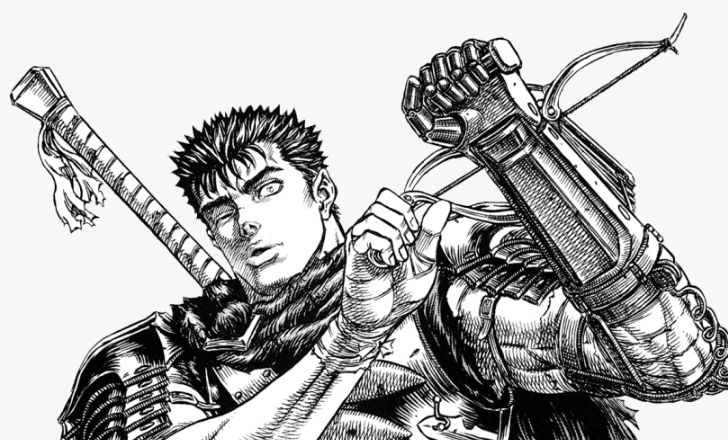
a man.
Berserk returned this month, so I’ll spare you my Gutsca fanfic. For now. But as always, social media was ablaze with speculation, theory, excitement and just general happiness at getting to read Chapter 360 after an eight-month wait. Chapter release month is my favourite part about being a Berserk fan; it’s usually when I get to connect with new fans, read interesting interpretations, and at last see some new content besides the ten “Miura’s the best artist” tweets that clutter my feed every day.
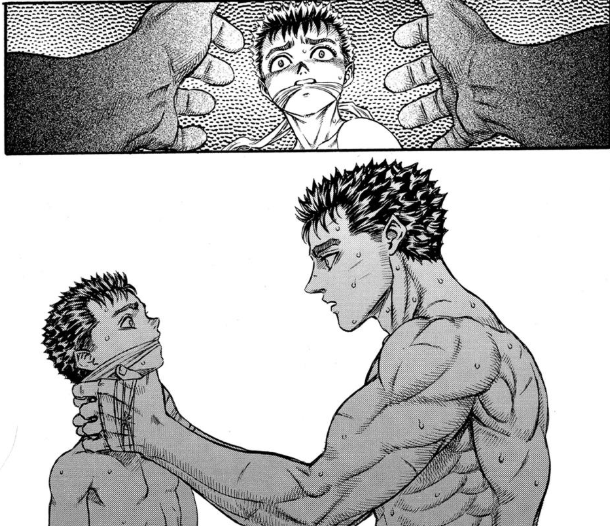
Some discussions are cyclical, but welcome: will Guts leave the travelling party to do his own thing? Will Griffith come to Elfhelm? How will Moonlight Boy help Guts and Casca? And, who will use the Behelit? Other topics are less interesting to me, but I know that for some, speculating over Guts’s possible return to a revenge quest is a novel idea, or arguing that Griffith and Femto are two separate entities is invigorating, so I can tolerate them. Other subjects are beneath contempt. One of these is the suggestion that Casca “enjoyed” being raped. Another is that her frightening reunion on the Hill of Swords with Griffith is proof that she still loves him. Lastly is the trivialisation of Guts's abuse as a child by way of Donovan memes, and the inevitable debate around dark humour, irreverent jokes, and lighthearted banter to lighten the mood around a sensitive topic.
Let me know when I should laugh…
Believe it or not, I was once a stupid teenager. I used to browse 4chan. I giggled at the evisceration of popular internet personalities on Encyclopaedia Dramatica. I gorged on popcorn whenever a drama unfolded on DeviantArt, and goaded people into fights on Runescape. I understand that for some snotty teens, a muscular black man raping a little boy in a tent is perfect Def Jam fodder. I roll my eyes at it. I mute them. I ignore it and move on. They’ll grow up. So imagine my surprise when I browse some of these twitter or reddit accounts, and see grown adults in their twenties, giggling about rape and memeing Donovan in an Easter bunny suit with fourteen-year-old kids. When certain jokes remain unchallenged, certain brains remain undeveloped.
Interestingly, most of these jokes are made by men. Berserk is one of those rare stories that centres a strong man trying to overcome PTSD in various ways. In a world of “men’s rights activists”, you would think such a story, told in such a delicate and sensitive way, would be appreciated. I am yet to see a Casca rape meme and I hope I never ever do, but I think it’s notable that the rape of a young boy is something that men and boys make fun of, and then many of these people will turn around and berate feminism for not taking male domestic violence and rape seriously. I recently discussed my discomfort with these jokes with one of my cool mutuals, which then made me ponder the amazingly subversive genius of Guts. Miura gave him the fragile background often attributed to femininity in most media. His journey and his experiences counter what we’re told to believe about manly, ultra masculine men, and yet he is still monstrously manly at the same time. Let’s discuss that.
Poor Guts.
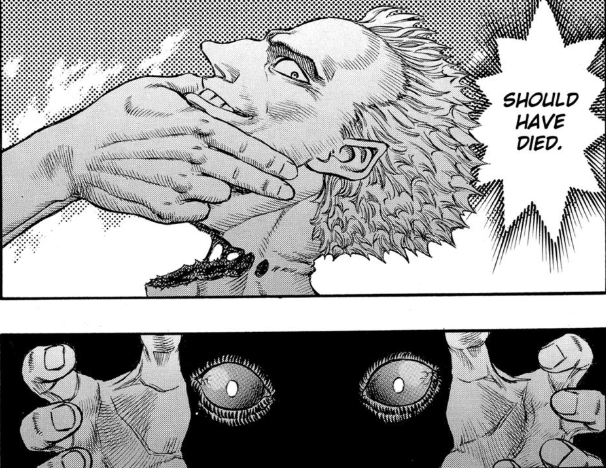
I’ve spoken about Guts’s struggles in other essays. Born from his mother’s corpse, Guts is adopted by the mercenary Gambino and his troupe at the behest of Gambino’s wife, Shisu, who eventually succumbs to an unknown illness. Gambino pushes Guts to join his mercenary band and take part in battles, but he is clearly rough with him, and his feelings towards Guts’s wellbeing are made purposely ambiguous until the night Guts is raped by Donovan after paying Gambino for the pleasure. Despite the betrayal, Guts is still desperate to please his father figure, and he never talks to him about the rape. After several years on the battlefield, Gambino suffers a debilitating injury, blaming Guts for his downfall. Their strained relationship escalates one night when Gambino attempts to kill him. Guts defends himself, accidentally slits Gambino’s throat, and is then driven out of the camp by his mercenary comrades. From this moment on, Guts lives a lonely, violent life, fighting for his survival on battlefields. Things change when he joins the Band of the Hawk as a young adult.
Guts is haunted by Gambino’s ghost.
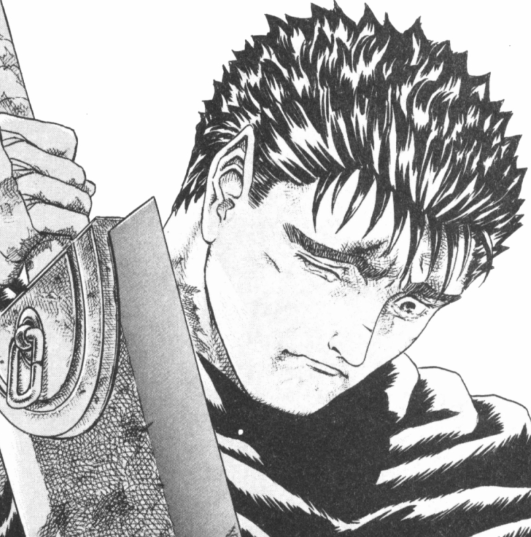
However, Guts’s introduction to the reader never belays any of this tragedy. A tough guy in black leather, he is rude, lewd, and violent. For a lot of first time readers, his behaviour is jarringly “edgy”. It’s not until the penultimate page of the Black Swordsman Arc, immediately after cussing Theresia for filth, that a glimpse of Guts’s deep-seated agony is revealed. A wordless panel, a downcast swordsman, beaten and bloody, a quivering frown, and eyes brimming with tears. The contrast is shocking. At last, we have evidence that there is something more to this man than meets the eye. We are then taken into the Golden Age Arc, during which his childhood tragedies are explained, and we follow his rise through the mercenary world. Volume Three of the manga ends with Donovan’s rape. It’s almost hard to believe that the insanely strong man that slaughtered demons was once a helpless child, mercilessly abused, but in many ways, it makes sense.
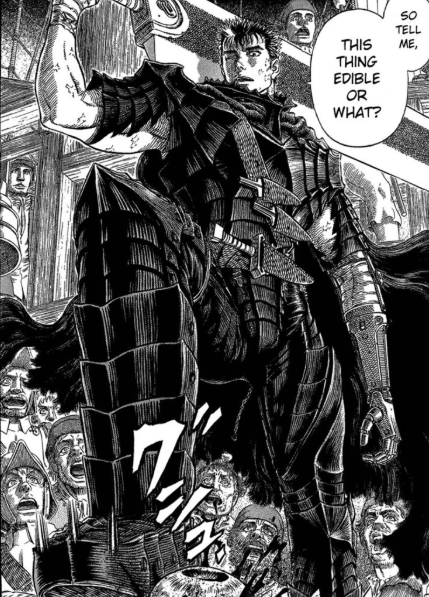
A MAN.
Guts is a chad. Everyone would hate him if he really existed. He’s way too strong, and way too handsome. He could get any woman he wanted. As Serpico admits, Guts is “a man impossible to ignore”. When he fights Mozgus in the Tower of Conviction, his very charisma and strength encourages the troubled, pious Farnese to hang up the cloth and leave her faith. He turned Griffith into a different man, and he made Griffith “forget [his] dream”. Everything about Guts screams Alpha Male. No one stands out like him, and no one is as strong as him. One of my favourite fights in the series is his second skirmish with Zodd—it is honestly breathtaking to read. Somehow, Guts is able to go toe-to-toe with the most fearsome apostle known up to that point, causing him significant injuries. And despite all this, he is still overcoming an insane amount of emotional trauma.
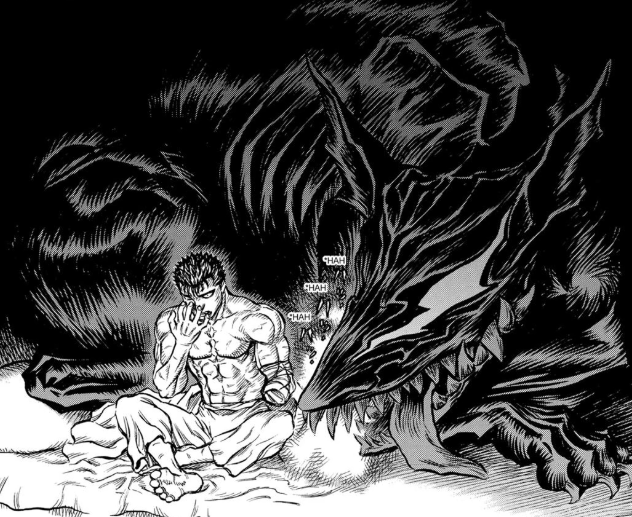
Like the black dog often used to symbolise depression, Guts is plagued by a “Beast of Darkness”, the manifestation of the dark, traumatic feelings that he has to contend with throughout the story.
The transition between aggressive edgelord to weeping man is what makes Black Swordsman the most intriguing arc of the series. That dialogue-free panel of the tearful Guts firmly suggests that all his bravado is a fragile facade. We are teased again when he instinctively begins to self-harm when confronted with the deformed apparition of his son. The self-harm is the first time we see Guts under pressure with himself, fighting against the tempest in his head. All this culminates in his fight against the Count and then the Godhand, where we finally see Griffith for the first time, and ends with that tearful panel at the arc’s conclusion. When the Golden Age starts, we want to know the story behind those tears, and after his childhood is revealed, everything about his Black Swordsman persona makes sense. But the Guts of the Black Swordsman is not a badass fighter. He is emotionally scarred, mentally weak, and in distress. The tough exterior is a comfort blanket.
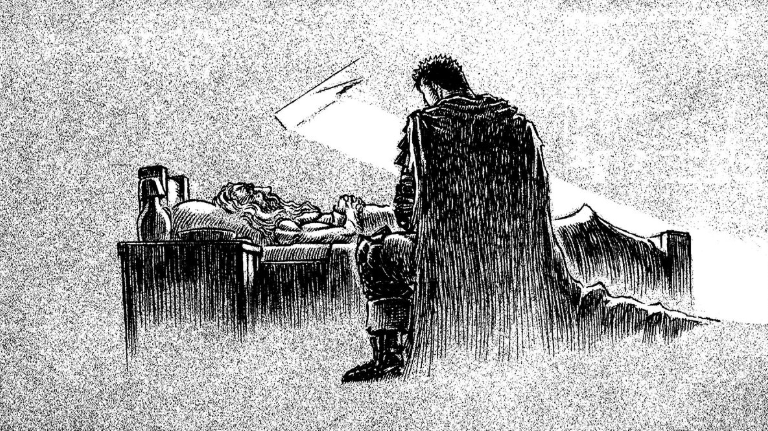
When Godo speaks, you betta listen.
Fast forward to Conviction, where Guts is once again faced with the terrors of his past in the form of Rosine, Jill, and the Misty Valley children, and then taken to task by Godo upon his return to a Casca-less cottage. Godo goes on to give one of the most poignant speeches in the series:
The thing about hatred… it’s a place where people who can’t look sorrow in the eye without waverin’ run off to…You’ve got some huge nicks in your heart. Damn cracks called fear… runnin’ all through it.
These words, coupled with the realisation that Casca—his most precious thing—was left alone whilst he ran around the world searching for Griffith, totally dismantles his tough-guy exterior. The anger, the hatred, and all the killing are signs of Guts’s fear. It was a fruitless journey, one that cost him both mentally and physically, and put Casca at risk when she needed him the most. At last, Guts is forced to face the fear and pain in his heart. Facing the horrors within himself is the first step in Guts’s healing process, and with these new convictions, he successfully rescues Casca and develops the capacity to trust and befriend others. Notably, Casca helped him come to terms with the horrors of his rape during the Golden Age Arc. It is a mark of just how deeply he descended into madness that he ran and left Casca alone after the Eclipse, especially after all she went through herself.
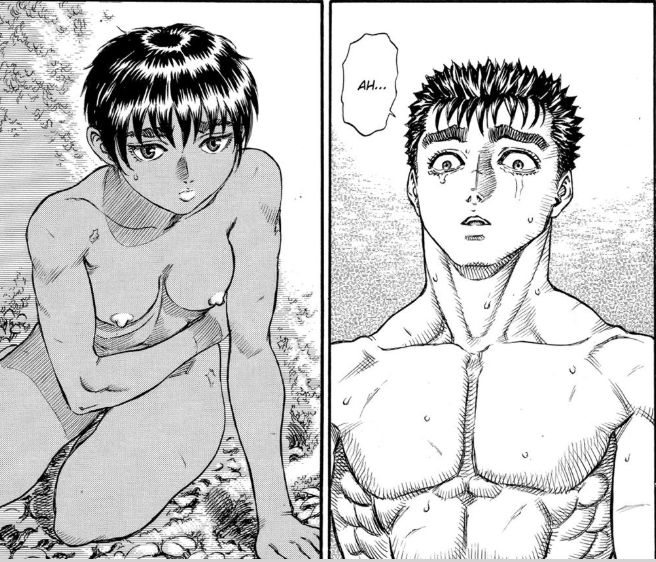
From Episode 47 “Wounds”. Nothing tops this chapter for me. I love it so much.
Especially wonderful is his relationship with Puck. During the conflict with Farnese’s Holy Iron Chain Knights, Guts suffers a flashback of the Eclipse which is so strong that the image flashes in Puck’s mind. Later on, when Skull Knight tells Guts that there is a way to cure Casca, Puck is pleasantly surprised by Guts’s soft expression, noting that Casca must be really special if she can trigger such a response in his normally aloof companion. And as Guts begins his transformation and embarks upon his own journey of healing, his relationship with Puck improves until they become friends. They provide a visual contrast: massive, leather-bound Guts with a sparkly elf in tow, the former reliant on the latter for physical healing and strength. We know that without Puck, Guts would be nothing, and Guts rightly acknowledges this. His ability to rely on the supposedly weak and insignificant characters once again challenges the toxic, patriarchal belief that men are supposed to be self-reliant, unmovable towers that the whole world should lean upon. For Guts, his ability to acknowledge his weaknesses is just a part of his masculine charm, as manly as his prowess with the sword and his inhuman endurance.
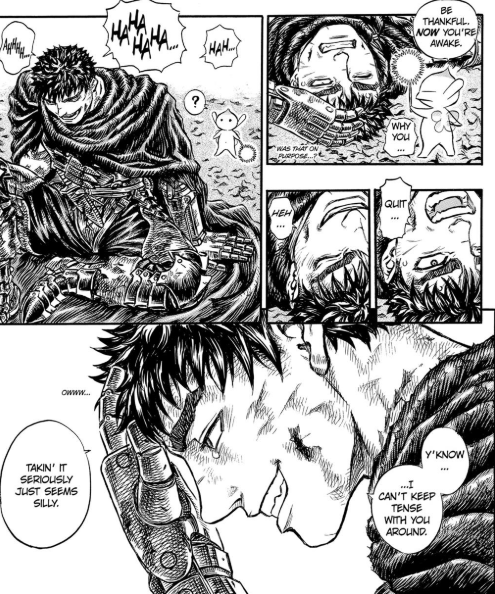
Succumb to Puck’s nonsense, Guts!
With Guts, Miura has not only created a foil to the ultra-masculine archetype, but has enhanced what masculinity should mean for us today. It abnormal for a character of Guts’s manly dominance to also be a survivor of rape and child abuse, a victim of betrayal, a man hopelessly in love and in want of companions. As he navigates the world nursing the effects of PTSD, Guts challenges the unrealistic portrayals of men in mainstream media. This is not to say that sympathetic stories about males are nonexistent. Shoto Todoroki from My Hero Academia is a quiet, detached character and a child abuse survivor. Furthermore, Yuki and Kyo Sohma from the wonderful Fruits Basket are also child abuse survivors, and their character traits (Yuki’s quiet, sombre demeanour contrasted by Kyo’s uncontrollable aggression) are direct results of this. But these characters are all teenage boys in teenage-level stories, existing in a context where emotional issues are anticipated amongst hormonal changes and general school drama—couple these aspects with child abuse, and the mental/emotional responses are expected to be more severe.
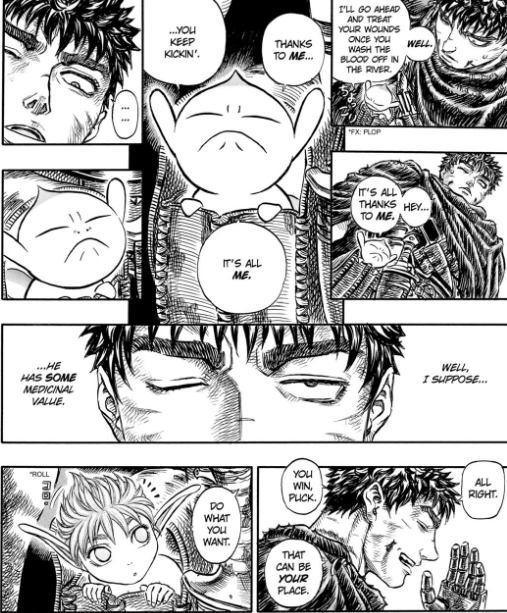
DAMN STRAIGHT. Also, this is the first time Guts calls Puck by his name.
In contrast, Guts is an adult man in his early twenties, living in a social context where boys become men prematurely. He is not supposed to have so much baggage, and his story is not supposed to be so emotionally sensitive, because patriarchal society has equated emotional intelligence to femininity, and femininity is weakness. It is refreshing to see a character like Guts overcome the masculine-attributed models of aggression and carelessness, to finally come to terms with his emotional pain, his past, and his feelings. And Miura expertly displays the realistic effects of complex trauma, from Guts’s early haphephobia, to the Beast of Darkness that haunts him whenever he is distressed, and even the split personality traits in Black Swordsman. We see all the complex stages of Guts’s pain throughout the story, right from Black Swordsman to Elfhelm. In a great mark of brotherhood, Roderick and Serpico sit and drink with Guts to ease his anxiety. Once again, we see that emotional intelligence, companionship and camaraderie are traits that are not opposed to masculinity, but are quite clearly a part of it.
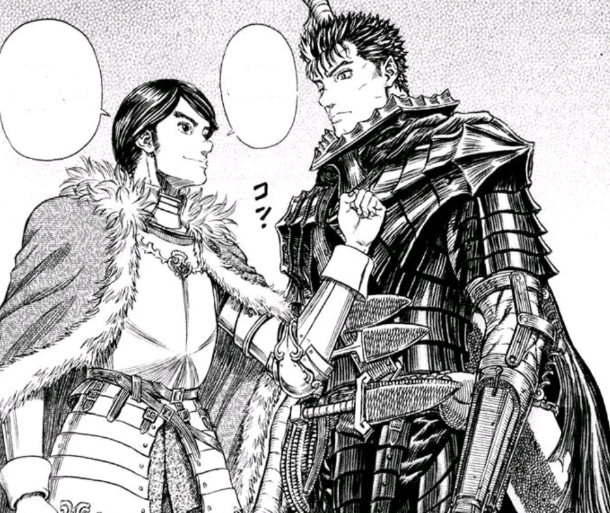
The MANLIEST of MEN.
As a woman, I write about Guts and masculinity as an outsider looking in. Girls are socialised to be more “in touch” with their emotional sides. Conversely, emotions and tears in young boys are mocked, and by the time the boy has become a man, it is outright shameful to acknowledge that something bad may have happened in his past. I wonder if the Donovan memes lend weight to this idea. Somehow, the only way for some men to acknowledge the discomforting nature of Guts’s child abuse is to make jokes about it. I won’t go as far as to label it as a coping mechanism, but it is definitely a means to overcompensate for a topic that is upsetting, and one that does have an effect on the world outside the manga. We are influenced by the media we consume, after all, and Guts is a positive influence, countering the unhealthy depictions of masculinity we are bombarded with everyday.
Maybe that’s something to think about before sharing jokes about a boy getting raped in a story.