Berserk, And The Power of Friendship
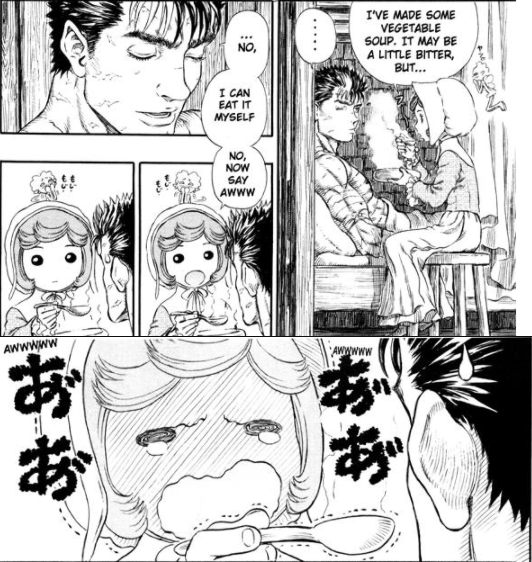
wholesome Berserk is best Berserk idc
I’m going to talk about the Power of Friendship in Berserk. These days it’s used as a derisive term thanks to popular shonen like Naruto and Fairy Tail, the latter infamously known for main characters defeating final bosses after staring longingly at their injured friends and getting literal power ups, super saiyan glow and all, displaying special abilities never before seen and never seen again. I do believe that Hiro Mashima (Fairy Tail’s author) is aware of these criticisms, as the opening chapters of his latest work, Eden’s Zero, gives much reference to friends and friendship in an almost satirical way.
I don’t think there’s anything wrong with Power of Friendship tropes, and whilst Fairy Tail is an extreme example, there is an unmistakable thrill that you get as a reader when Natsu flashes his “shit’s just got serious” glare at his antagonist, triggering sighs of relief and gratitude from Lucy or Gray or Happy or Erza. It’s those hope-filled panels from his friends that makes those moments so special, because you realise that Natsu, despite his formidable power, is nothing without the people who love and care for him, and even though he has the ability to fell the biggest and baddest wizards out there with abilities that could control thousands, all he wants is to chill with his guild, have fun, and be someone his friends can rely on. And we as readers might be without fire-breathing powers gifted to us by legendary dragons, but we empathise with Natsu’s very human and very normal desire to be wanted and loved by others.
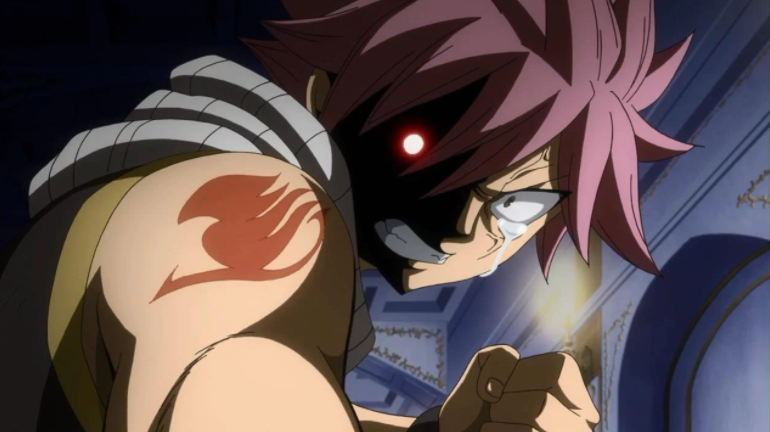
Lol say what you want about Fairy Tail, it has some cool moments.
Berserk has its own version of the Power of Friendship that I think goes much deeper than “when I see my friends get hurt I reach deep inside myself and will my muscles to explode like Popeye”. Miura uses companions to explore how a healthy friendship is one of both positive affirmations and well-intentioned chastisement. Friends are more than extra bodies to dispel loneliness, but they help you grow as a person because they call you out when you err and provide ways for you to improve yourself, and when you are without those things, you decay.
In the Band of the Hawk, Guts is never without chastisement. The main thorn in his side is Casca. She critcises his brashness and the way in which he rushes towards danger, inevitably dragging his fellow mercenaries along with him. Guts constantly battles with her words, not only because he is in love with her (although he’s not aware of this in the beginning), but because his life before the Hawk was one of solitary loneliness, where he was betrayed by the adults around him and forced to rely on himself. It’s clear that Guts doesn’t rush into danger because he’s self-confident, but because his childhood of abuse has led him to not see the worth of his own life. Griffith notes his fighting style, how Guts is only ever an inch away from death not through lack of skill, but more to do with seeing himself as expendable.

When Griffith puts himself at risk for him, Guts is bewildered, and even more perturbed by Griffith’s response to his bewilderment. When Guts leaves the Band and forges his own path, he is once again in disbelief when Casca tells him that Griffith lost his mind after he left. His facial expression is one of horror: “how can I be so special, little insignificant me, that my departure caused such destruction?” As an aside to this, Guts’s surprised response to Casca reciprocating his kiss is another small indication of how lowly he views himself . It seems that everyone but Guts knew how she felt about him.
The glimpses of interactions we see between the mercenaries makes it plain that they aren’t afraid to chastise one another when they think someone else’s behaviour is stupid. Corkus, never one to mince his words, outright tells Guts that he never liked him on the night of his departure. Judeau tends to be the mediator, identifying the motives behind others’ actions and subtly presenting them with an alternative—his final conversation with Guts on the same evening is a perfect example of this; how he tells Guts that he knows about his feelings towards Casca, and then implies that she would be better off leaving with Guts instead of staying with the Band.
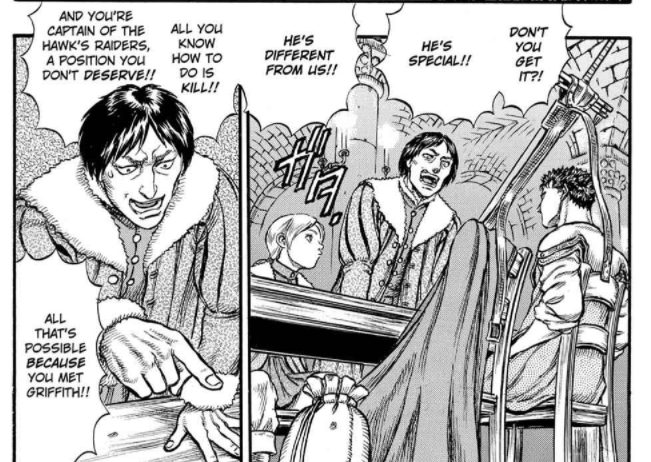
Corkus: motivational speaker and self-esteem champion
Because the mercenaries see each other as equals, they don’t mind calling each other out in addition to commending one another when things go well (which, for the Band of the Hawk, is very often). The person they don’t see on their level is Griffith.
The Band of the Hawk treats its commander as a God rather than a friend. Griffith is always apart from and above them. He has his own machinations and plans that he never discusses with them. His strategies are formed within his own head and then dictated to the others, and they follow due to their unshakable devotion to him. Everyone knows that Casca loves Griffith to obsession, and they also know that Griffith has his eyes on Charlotte, but we never see anyone encourage Griffith to let her down nicely so that she can move on. They all watch the drama unfold with unspoken discomfort, wishing her the best anyway. Judeau telling Guts that Casca would be better off leaving with him is the closest we get to an indication that the other mercenaries would rather Casca find happiness elsewhere.
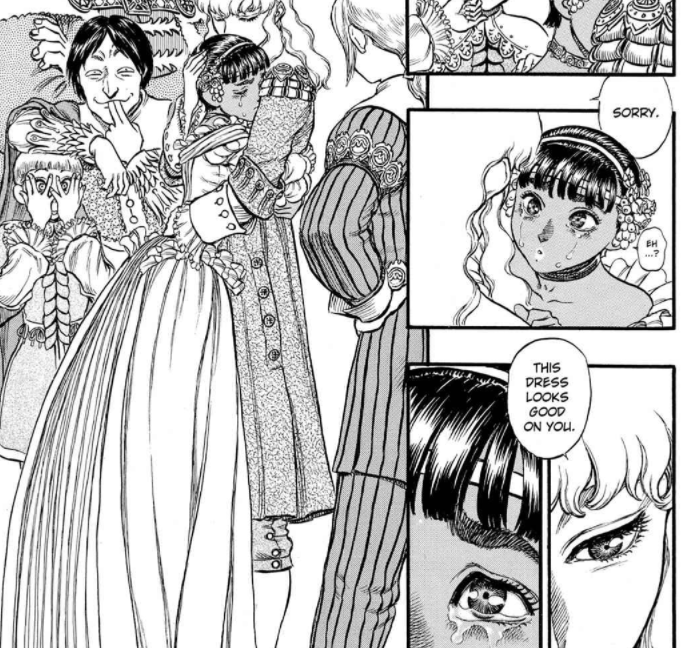
smh…
Griffith needs Casca’s devotion. Its unashamed openness becomes the emotional pulse of the Band, giving them the heart to also devote their minds and bodies to Griffith’s dream. Were Griffith to kindly tell Casca to find love elsewhere, she would most likely succumb to a depression before putting her own happiness first. And what would that look like? Would she leave the Band? Stop being a mercenary? Be honest with herself about her feelings towards Guts and begin an open relationship with him, thus turning everyone’s attention away from Griffith and onto herself? Whatever she could choose would be detrimental for Griffith, and so he allows her to hope that maybe something could happen between them. All of this is bad, but Griffith is never told so.
When you are constantly the main character not only in your own life, but in the lives of everyone around you, you put yourself first in the most narcissistic ways. Griffith’s sudden downfall with Charlotte was without any consideration to how his actions would impact everyone else. His dramatic manipulation of Casca’s kindness after his rescue is his way of positioning himself as first in her life, and thus everyone else’s, even if he has to look weak and helpless in the process. He eventually runs away in despair with the sentiments of departure of his former soldiers ringing in his ears. As everyone makes plans for their own lives, Griffith ensures he remains the centre again. The Eclipse is obviously the ultimate result of Griffith’s self-centeredness. Now, he really is the most important thing, even among the frightening Godhead—why would he give that all up to remain weakened and alone?
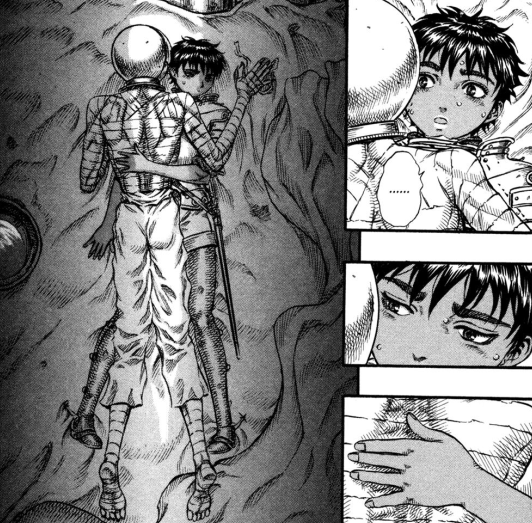
GET A JOB. STAY AWAY FROM HER.
Upon his reincarnation, Griffith gathers apostles who are once again religiously devoted to him. The humans he acquires likewise deify him, and even though there may be the occasional dissenter (like Rickert, Rakshas, and Ganishka), when the whole world loves and wants to follow you, why would you care?
Whilst Giffith is surrounded by yes-men, Guts interacts with individuals that are no strangers to rebuke. Puck constantly criticises Guts during his darkest moments at the start of Conviction (and of course Black Swordsman). When Guts returns to Godo’s house, the swordsmith challenges Guts for leaving Casca and then having the gall to get angry at Rickert when he loses her. Without Godo’s words, Guts would never have the conviction to “never lose her again”, and devotes the rest of his life to protecting her.
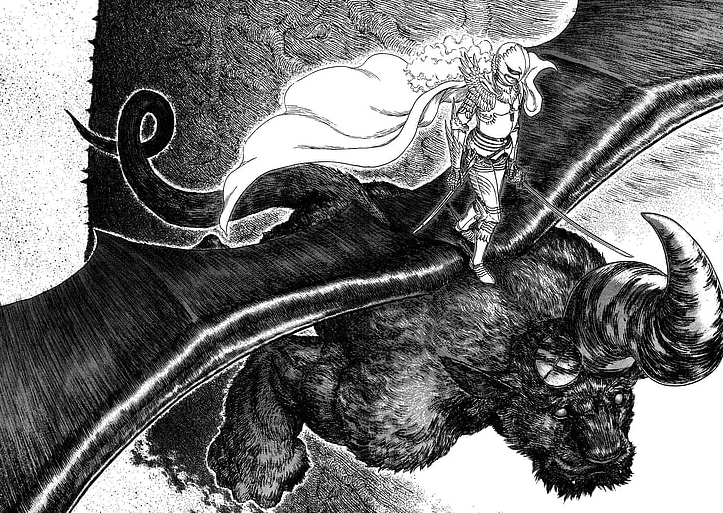
Griffith and Zodd make a cool pairing but after seeing him team up with Guts to fight Ganishka, GutsxZodd is my OTP.
After the battle on the Hill of Swords, Puck reminds Guts that he can in no way continue his path of vengeance and protect Casca at the same time, and Guts agrees, albeit with frustration, but Puck’s necessary words softens Guts’s heart to enable him to agree on the Elfhelm plan. Puck refocuses Guts’s attention to Casca—his most important thing—and warns him against going down his previous vengeful path.
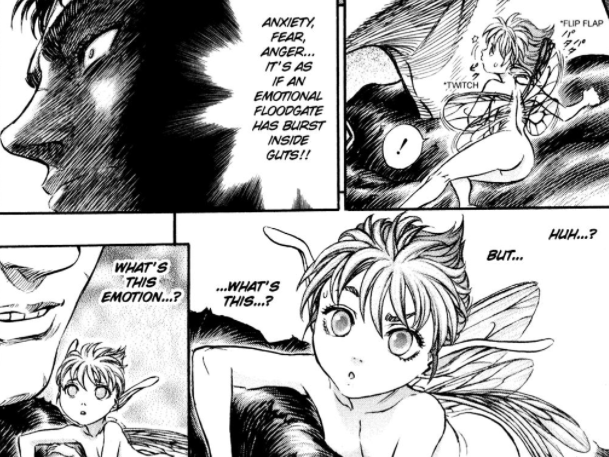
Puck being able to feel Guts’s emotions is also a great device for his empathy. Puck chastises Guts because he understands him better than most members of the Party.
Farnese is a brilliantly interesting member of Guts’s crew. Living her life behind a gilded cage, she joins the Holy Iron Chain Knights as their commander. And even though she is a powerless figurehead, the soldiers treat her like a princess, fighting to protect her and listening to her every whim. Serpico is devoted to her without question: passively participating in her sadism and allowing himself to be the emotional/sexual refuge she needs, away from her stifling aristocratic life. When she joins the Knights, Serpico follows, even though we’re not sure what his religious beliefs are, and when she leaves to join Guts, he unquestionably follows again.
When Farnese confronts Guts, she is faced with the darkness within herself. His tenacity and self-reliance triggers her insecurities, and as her religious beliefs unravel, so does her unhealthy narcissism. She is humbled as a member of the travelling party; a motely crew with no leader or hierarchy, and she abandons her former way of life. The Travelling Party is honest; the members are all faced with their own weaknesses—Isidro and his feelings of uselessness, Schierke and her naivety, Magnifico and his greed, Roderick and his privileged upbringing, Isma and her isolation, and Serpico and his stoicism. Knowing that they all have personal issues to overcome, they work together to be better people and to better the lives of others.
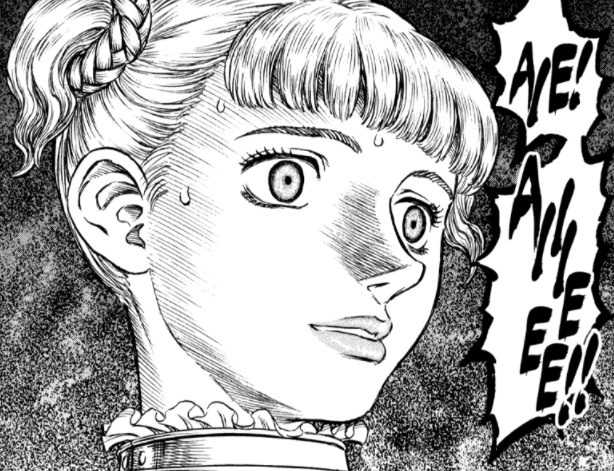
… she’s come a long way.
Another contrast I think is important is the Guts/Schierke and Griffith/Sonia dichotomy. Both Guts and Griffith have a witch confidant, but whereas Sonia idolises Griffith like a neo-Casca, whipping anyone who might doubt him into unquestioning devotion, Schierke constantly reminds Guts that he is human and fallible. She is angry when he pushes himself too far, she chides his recklessness, and acts as a literal conscience when he is using the Berserker armour to ensure he doesn’t succumb to its indiscriminate bloodlust.
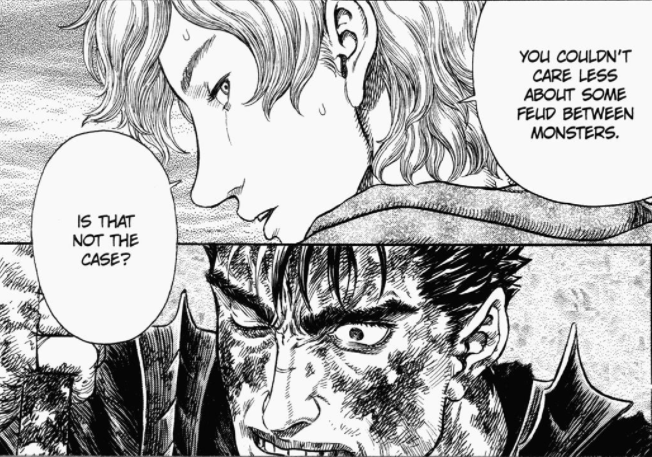
When Schierke sees Serpico’s fear of Guts’s armour, she assures him she would never let him hurt anyone else, and when Guts is torn between protecting his friends and getting the chance to go toe-to-toe with Zodd again, it’s Serpico who reminds him of his purpose. Guts, noting that Serpico is talking specifically about Casca, reigns himself in and ends his fight with Zodd. This is such a powerful moment of progression in their relationship, and I think it’s a great way to highlight the constant exchange of trust, chastisement, and respect amongst the Travelling Party. This alone is evidence of their superiority to Griffith and the Neo Hawk.
swoon
With the final chapter of Berserk released, I would have loved to see how Moonlight Boy would have added another element to morality and conscience in the story. We know that during times when Schierke has failed, the Moonlight Boy has saved Guts from succumbing to evil. And with that final tantalising page of Griffith’s single tear as the Moonlight Boy is transformed into a Hawk of Light, one can only wonder how his presence within Griffith’s vessel would affect his plans for domination later down the line. However, this, as with everything else, will remain an unrealised dream.
I still have hopes that it may be a dream deferred…