Guts, Griffith, and Charisma
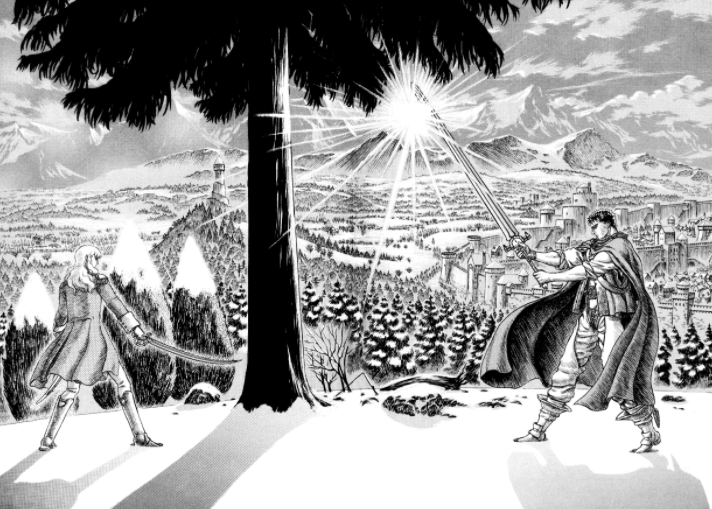
It’s been a long time since I’ve written about Berserk (July last year!) even though some great things happened in 2020, such as the announcement of the 30th anniversary exhibition taking place in Japan, complete with a crowd-sourced Zodd! It’s great to know that Miura’s series is still so popular, and that after three decades, the fandom continues to grow, not just in his home country, but around the world. Last year I connected with Berserk fans in the US, France, Germany, the Netherlands, and everywhere in between and the enthusiasm for recent developments in the story is bigger than ever.
It’s hiatus time. Now that we’re finally getting a Skull Knight backstory, we can start to connect parallels between the fallen king and our hero, Guts, especially his similarly antagonistic relationship with Griffith. When I saw the panels of Skull Knight facing an early iteration of the God hand, still headed by Void, it conjured all sorts of theories for how the ongoing battle between Skull Knight and Void would affect Guts and Griffith, and I was reminded of an interview in which Miura said the key to the God hand’s conclusion lies with Void. I wonder then, if Void had a similar debut to the cosmos that Griffith had? Had he come from humble beginnings, and did he also nurse a costly ambition? How did he behave when he was human? Was he contaminated by delusions of grandeur?
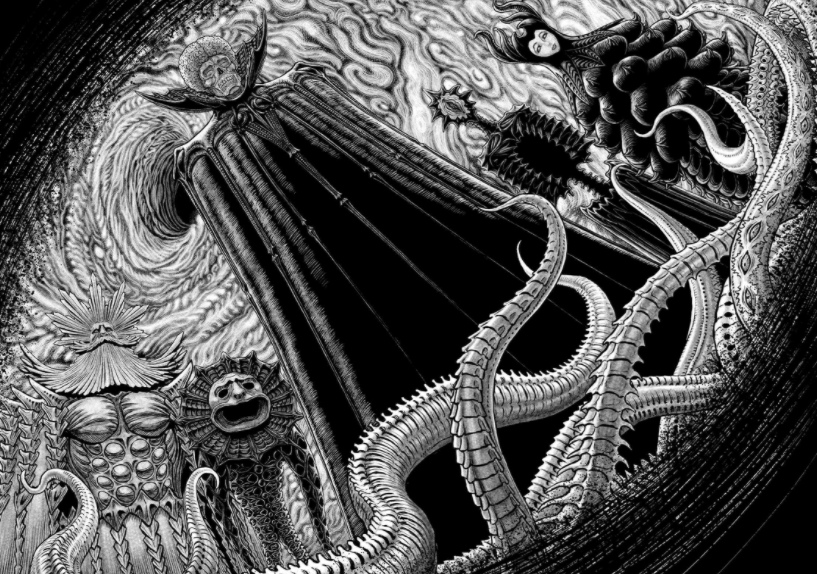
Okay there is a LOT going on here.
I ask all these questions because undoubtedly, Griffith the human is remarkable. Without his natural charm and charisma, his meteoric rise through nobility would have been impossible. It’s hard to determine whether his personality was innate, or if it grew out of his desire to overcome his impoverished beginnings. Either way, by the time he is a late teen, he is already leading the Band of the Hawk and enjoying the unwavering trust of his comrades.
On the flipside, when Guts meets Griffith (and the rest of the Hawk), he is the total opposite. He kills one of Griffith’s men (not like he had much choice), and immediately rubs everyone the wrong way. In fact, Guts always seems to rub people the wrong way, or at least that’s how he’s presented to us in the beginning. And yet, he has managed to lead his own smaller band of followers, a ragtag group of oddities who have constantly risked their lives for him without even properly knowing his full background. Guts too has is own charisma, but it is so distinct from Griffith’s. The contrast is really interesting to me.
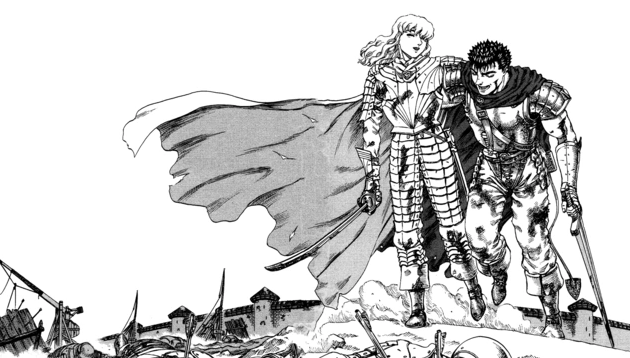
When things were good…
We don’t know much about Griffith’s childhood other than the snippets from the Ubik-induced memory trip during the Eclipse. We see Griffith living in squalor with his friends, innocently languishing in the shadow of the great castle of Wyndham. During one of his regular jaunts out in the town, an unknown mystic gives him the Egg of the Emperor, setting his life on a path he is still too young to conceive. The next time we see a younger Griffith is through Casca’s and Guts’s origin stories. What we know of Griffith is his unmistakable beauty, slight, delicate demeanour, and his skill and prowess in battle. As noted by everyone who meets him, his fragile, ghostly beauty and obvious leadership presence distinguishes him from other commoners. He knows how to use these features to his advantage, and he not only drives his Band to near-miraculous victories during the war, but captures the heart of Princess Charlotte.
It’s telling that the Band knows that Griffith’s ambitions are solely for himself, and yet they are still so devoted to his cause over their own. Corkus, Casca, Judeau, and Guts all note that Griffith is driven by his personal passions. They all respond differently to this: Corkus is satisfied to live in Griffith’s shadow if it means he can get a small glory for himself, Casca is conflicted due to her unrequited feelings, knowing that Griffith’s eyes are on Charlotte. Judeau is ambivalent, and Guts develops an insecurity that eventually leads him to leave the Band and try to find his own purpose in life. He wants Grffith to see him as an equal, and not a pawn.
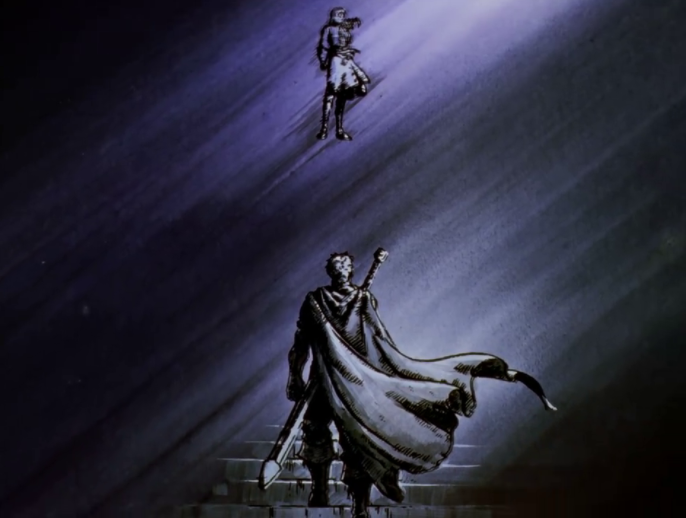
Such a pivotal moment. When Guts overhears Griffith’s conversation at the top of the stairs, he realises that the man he thought was his friend doesn’t consider him an equal. From there, he decides to carve out his own path in life—something he has EVERY right to do, but you know how Griffith is…
This responsibility is not without personal cost. Griffith feels genuine guilt and remorse when he sees the fallen child soldier in episode 17. A burden of leadership is placed on his shoulders as it becomes real to him that his bandmates are literally dying for his dream. This then leads him to put his own body on the line, enduring sexual exploitation from Gennon in order to finance the Hawk. When Casca finds him afterwards, he explains, in a trauma-laced trance, that if everyone else is sacrificing themselves, he has to do the same.
It feels like this scene is foreshadowing the sacrifice he eventually makes in the Eclipse. On one hand, he once again sacrificed the bodies of his men to ascend to the God hand, but this came at the cost of his heart, his previous bonds, his conscience, and his guilt. He had to force himself to sever whatever connection he had with his friends—especially Guts—to achieve his final goal. After all, behelits only work by sacrificing people who hold some special importance to the user. As shown by the Count’s situation, such a requirement is a major personal sacrifice in itself.
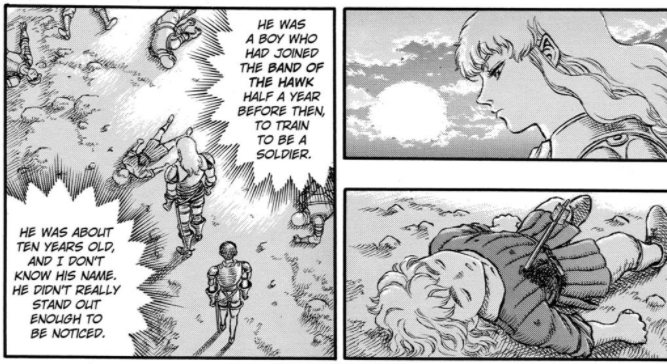
Throughout the course of Golden Age, Griffith hardens himself against these responsibilities, almost as if he knows that succumbing to sentimentality will cost him his dream. He ruthlessly leads from the shadows, using Guts to assassinate his political rivals, and all the while using his powerfully charismatic persona to woo Charlotte and the king.
His leadership style is distant and ambiguous. He tells Casca to follow him if she wants to, but conversely demands Guts to joins the Hawk. The pair’s relationship is complicated, and when Guts decides to leave, Griffith is controlling and aggressive. The language he uses here is stripped of all class and decency: Guts is a soldier he cannot afford to lose. He unravels when Guts wins the duel and departs; for the first time, things haven’t gone to Griffith’s plan—unfathomable still, someone in his inner-circle has managed to break free from the charisma he so effortlessly exudes. So caught up in his own hubris, he didn’t even realise just how much Guts had grown as a fighter over the years, let alone consider that his closest companion was considering an independent path. Griffith’s demands sound so similar to the language of abusive partners: “if I can’t have you, no one can”. It reveals his more sinister and self-serving nature.
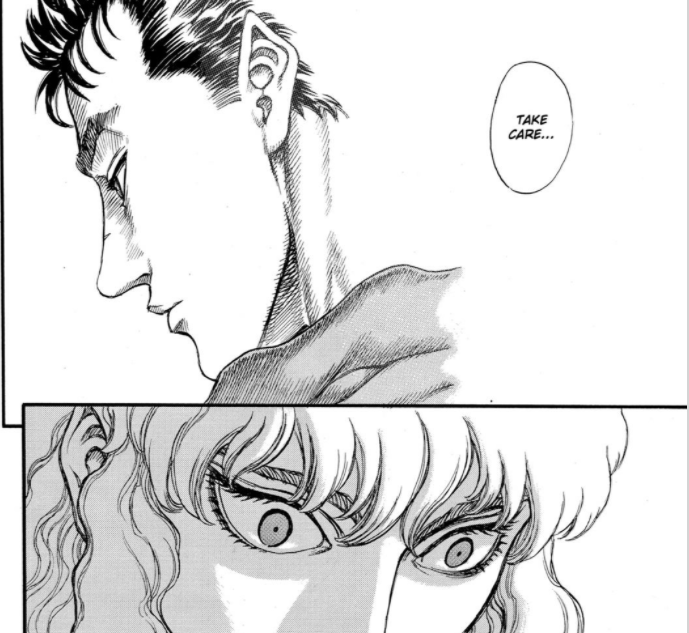
In contrast, Guts leads by sacrifice. He’s already noted by Griffith to have a destructive fighting style, often putting his own life in danger in order to preserve it, but it definitely comes clear when he goes to challenge Zodd for the first time. He feels almost ashamed that his men have died whilst he, their raid commander, sits outside. Rushing into the decrepit building with reckless abandon, he only starts thinking about how dangerous the whole thing is when he comes face-to-face with Zodd himself.
Guts’s fellow soldiers have understandable respect for him. Gaston and the rest of the raiders lavish Guts with praise because he’s damn cool, and loyal, and dependable, and can fight his way out of anything. Credit to Guts, he never lets any of this get to his head. This is so unlike Griffith, who is fully aware of the power he holds. To highlight this further: whilst everyone and their mother falls in love with Guts, he doesn’t seem to understand his attractiveness. When he goes to kiss Casca, he’s genuinely surprised that she wants to reciprocate. And he’s stubbornly platonic with Farnese, even though Serpico and Roderick clearly notices her affection towards him.
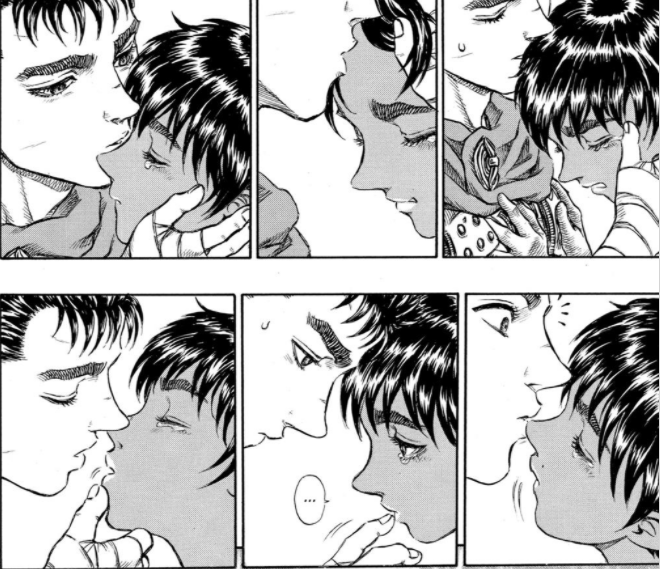
Absolute faves.
As Guts leads his travelling party, he’s often seen taking up the rear, naturally on the lookout for any dangers to the team. He compliments his companions regularly and vocalises his appreciation for them. When Guts leads his crew to rescue Farnese from her family, taking a major detour to do so, it’s all because he genuinely needs and appreciates her. It’s similar to when Guts and Casca fall off the cliff during one of the Hawk’s early battles. Unlike Griffith, who sends Judeau and some other soldiers to retrieve them, Guts leads his team himself. It’s important that he gets to tell Farnese how much she is appreciated, and even then, he still gives her a choice. There are no controlling ultimatums in Guts’s travelling Party; everyone has been told the same thing: “do what you want”. They have joined because they want to.
It might be this kind of democratic inclusiveness that has attracted such a strange mix of people to join him. They’ve all faced losses, and are all outcasts in some way, searching for somewhere to belong. With a leader without prejudice like Guts, and a leader that sacrifices himself so willingly for his team, it’s no surprise that they want to stay with him, and help him achieve his own goal. It’s near impossible to watch Guts single-handedly fight Ganishka, the Sea God, Mozgus, and others, and not think “maybe this guy’s on the winning team?” Guts leads by service, and very impressively so.
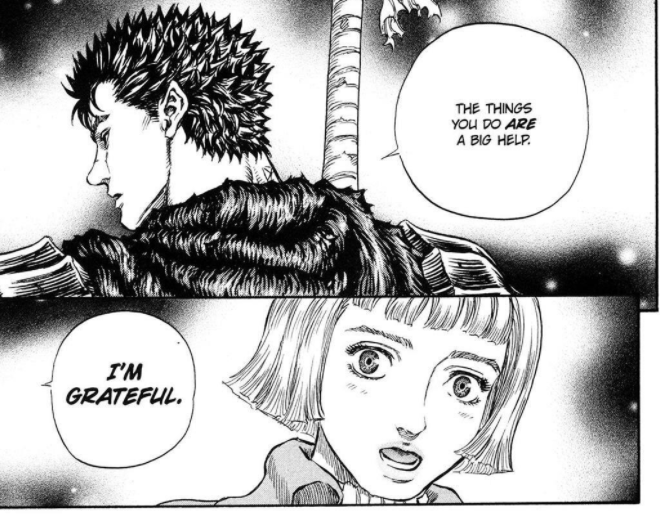
We’re all grateful, Farnese!
Guts and Griffith are constantly contradicting each other. Guts is an image of darkness and the Black Swordsman epithet carries the weight of fear and foreboding. By contrast, Griffith’s “Hawk of Light” persona is the perfect disguise for his true, selfish intentions. Just like the “false Christ” of the Bible, Griffith appears as a force for good, but beneath all the shiny armour is a leather-clad monster, and the marble bricks of Falconia hide a den of violent apostles, ready to murder anyone who doesn’t buy into Griffith’s dream (ahem, Rickert). Now that he has the supernatural on his side, he can trick people into accepting the apostles, even though they quite obviously pose a danger, and even though the world is a magical mess because of him, he is able to twist the narrative to make it seem like he has saved and protected everyone beneath the cover of Falconia.
It’s upsetting seeing Sonia’s unwavering loyalty towards him, and Mule’s unspeakable tears when they first meet, and even Laban and Owen’s gratefulness towards the Griffith of old. His current image is a farce, and when the delusion finally breaks, we can only imagine the chaos and destruction that will result from it. Guts rightly identifies Griffith’s icy resolve towards his ambition, warning his companions that he’ll stop at nothing until he achieves his ultimate goals.
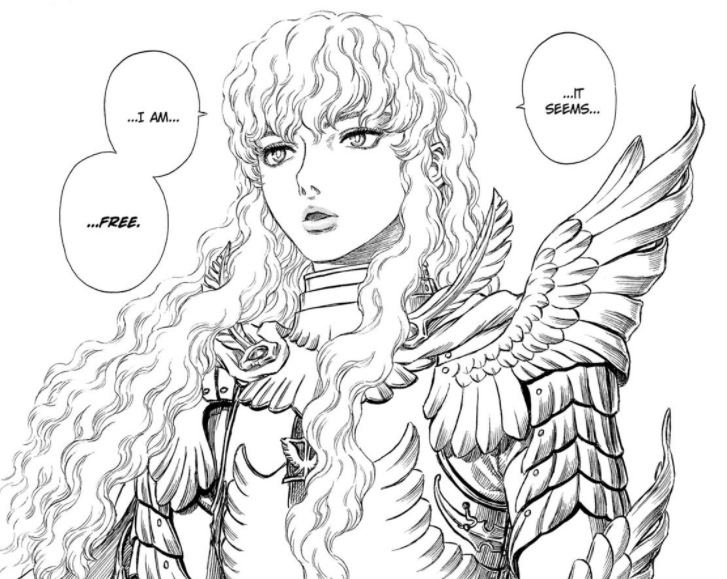
BAD. MIND.
Griffith tests his own commitment on the hill of swords. Now that he is finally free of all his bonds of the past, divorced from any potential feelings of guilt despite his betrayal, he can callously press on with his new Hawk, never falling to the despair that almost cost him everything in the first place. He’s not a leader anymore, but a god, and companions are indispensable.
As Berserk (very slowly) heads towards its conclusion, an obvious foil lies dormant in Griffith’s body: the vessel that he shares with Guts’s and Casca’s unborn child is alive and very well, as is the Moonlight Boy. It might be a case that a pure, unconditional bond is what defeats Griffith in the end, he who is too selfish to understand what a bond without coercion actually means. Perhaps Guts’s understanding of companionship, which he learned through his relationships with Puck, Casca, and the rest of his crew, will assist in Griffith’s destruction. But only time will tell.