Guts, Griffith, and the Fountain
Griffith securing the bag
Berserk is not in want of haunting moments. There are several. Guts’s final look of anguish at the end of Black Swordsman is one, his desperate scramble to find solace in his sword after Donovan rapes him is another, Griffith’s Ubik-induced dream atop a mountain of dead bodies is equally startling, Guts and Godo’s conversation on the latter’s deathbed always gives me chills: Adult Attack, the many images of a desecrated Wyndham in the wake of Ganishka’s rule, Flora’s incendiary departure…the list goes on. But one scene in particular sends me into a contemplative loop, and it is found in Episode 12 (28 in the tankobon)— the one with the infamous fountain.
Before delving into the scene itself, I think it’s important to highlight the ways in which Miura uses physical positioning as a visual metaphor for Guts and Griffith’s relationship. When Griffith first sees Guts, Guts is fighting the mighty Bazuso. Watching the battle from a high balcony overlooking the courtyard is Griffith, who silently observes Bazuso’s demise. Afterwards, Guts is accosted by Corkus and other Hawk members, and after almost killing Casca in the subsequent melee, Griffith arrives on the scene. He is above both Guts and Casca, atop his white horse, and slightly higher on the hill’s incline.
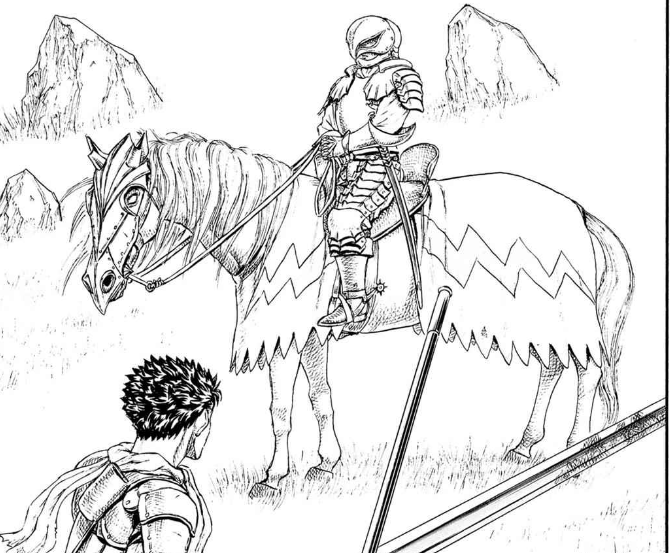
He certainly knows how to make an entrance…
Guts challenges Griffith, all the while the Hawk’s Commander remains on his horse, besting Guts as he now fights for his life against a rare, superior fighter. After his recovery, Guts challenges Griffith again, this time for his freedom, as Griffith now wants Guts to join his mercenary band. Although they are initially on even footing, Griffith gets the upper hand by physically elevating himself, perching atop Guts’s sword—his source of comfort—to win the fight. Not to be dissuaded, Guts topples Griffith to bring him to his own level again: he pummels him to the ground and they both engage in a fist-fight instead. Eventually, Griffith wins. He changes his position until he is literally on top of Guts, trapping him as a means to dislocate his shoulder.
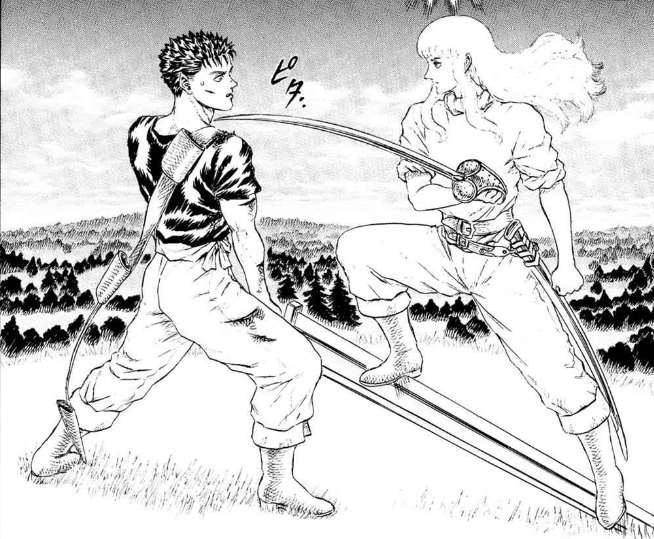
I would love to write something on how Miura choreographs his fights in general, because they are all absolutely stunning, and each character has their own unique fighting style that matches not only their personality, but their past burdens… but I don’t know if I have the skill to properly explain everything without it sounding like an MMA cheat manual or something. We’ll see…
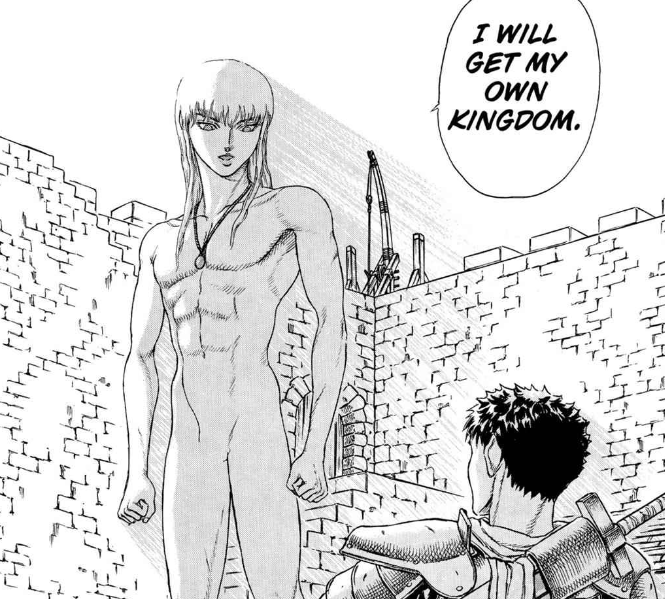
Eventually, Guts joins the Hawk to become the Raiders Captain. His position is at the rear of the band, whilst Griffith takes up the very front. We often see Guts sitting atop the parapets of their fort, contemplating, silently observing the city below him, occupying a physical space that is both alien and distant to his reality. It is after one of these sojourns that Guts chats with Griffith, which is one of the few times we see their positions reversed. Guts condescends himself to where Griffith bathes in the courtyard. Griffith is totally naked and vulnerable. During the pensive conversation, Griffith lowers his defences, breaking into a genuinely joyful laugh that catches Guts off-guard.
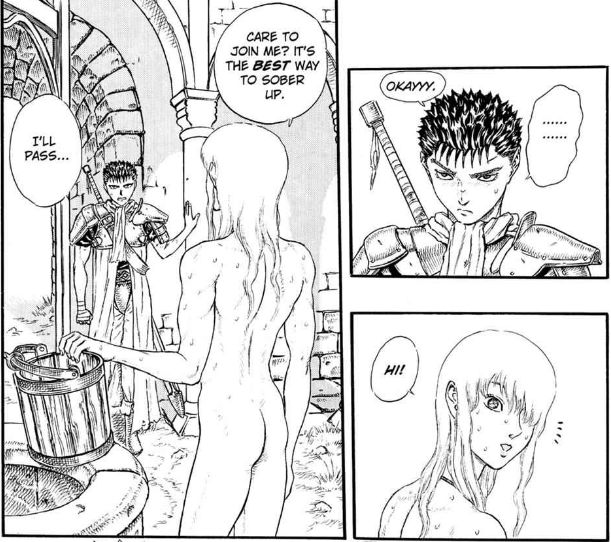
Just putting this here because it’s funny. Griffith down cataclysmic.
But when Griffith tells Guts about his true dream, to have his own kingdom with Guts as a key player in helping him achieve it, he reminds Guts and the reader of who he is. Griffith stands, the sun almost acting as a halo behind him, observing an awe-stricken Guts on the ground as he declares his life’s ambition. It’s a perfect scene. Griffith is both intimidating and celestial, and if there was any doubt that he was different from the Hawk, from his childhood peers, and the slumlords of his youth, here is Griffith’s defiant assertion of superiority.
Afterwards, Guts is thoughtful again as he questions his own journey: “where am I going? I still don’t have the answer to that, Gambino”. It is notable that Guts conjures Gambino in times of doubt and anxiety, especially because Gambino returns during the botched assassination of Julius.
As he scopes the manor, Guts witnesses Julius’ harsh treatment of his son, Adonis, during what should be a friendly session of sword practice between father and son. Guts can’t help but think about his own suffering at the hands of Gambino, and the memories almost spook him for the task at hand. This moment is clear foreshadowing for what’s to come: Guts kills Julius, and then he kills Adonis before he realises what he’s done. Both father and son, reminders of Guts troubled past, are murdered violently and haphazardly, but it is the death of Adonis that shakes Guts’s resolve. As a victim of child abuse, he is normally tender and hesitant around children. His face is filled with horror at the sight of Adonis’s dying body.
This incident distresses Guts so much that he is shown to be on the verge of vomiting, he almost blows his cover, and as he escapes the manor, he has no choice but to enter the sewers, during which he passes out in the putrid water. Gambino invades his dreams. Guts replays Gambino’s death, and then his other fear—Zodd—appears, who then kills the child Guts in a mirror image of the demise of Adonis.
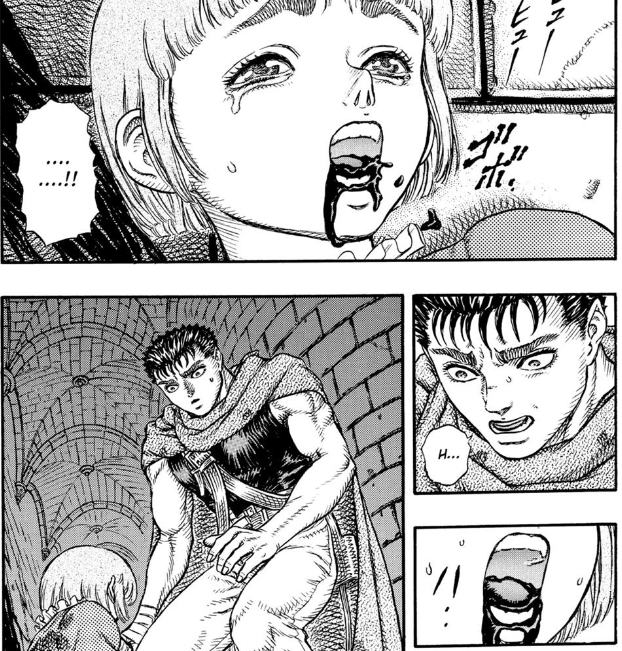
Poor Adonis :(
At this point, Guts is low. Physically, he is in the deep recesses of the city, and mentally, he is worn out. He wanders Wyndham in a daze, covered in filth and stinking of sewage water, reeling from a senseless murder and another return of the nightmare of Gambino’s mocking, severed head. It is in this state that he stumbles up the steps of the King’s castle, a curious Casca in tow, to give Griffith his report. Whilst Guts has been in the sewers, his Commander was at a banquet. Guts stops halfway up the steps, several metres below Griffith, watching as he chats with Princess Charlotte. They are both dressed the same, and Griffith looks every part a true noble. The difference between these two, and Casca and the dishevelled Guts, couldn’t be more obvious.
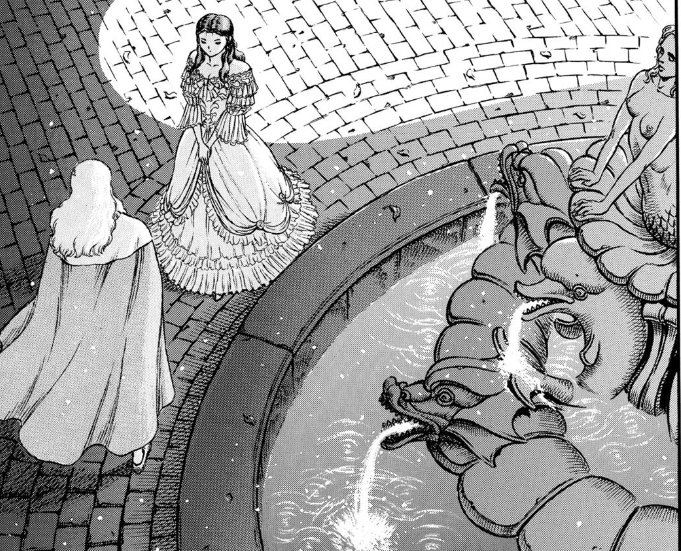
So at last, the fountain. It bubbles in the background as the scene unfolds. The conversation that Guts overhears is a simple one. Griffith explains the meaning of a Precious Thing, which to him is a dream. He says:
With no relation to social status, class, background. Whether it suits them or not, people yearn for a dream…
A man should envision such a lifetime once. A life spent as a martyr … to the God named Dream.
To me a friend is someone who would never depend upon another’s dream…
What I think a friend is, is one who is my equal.
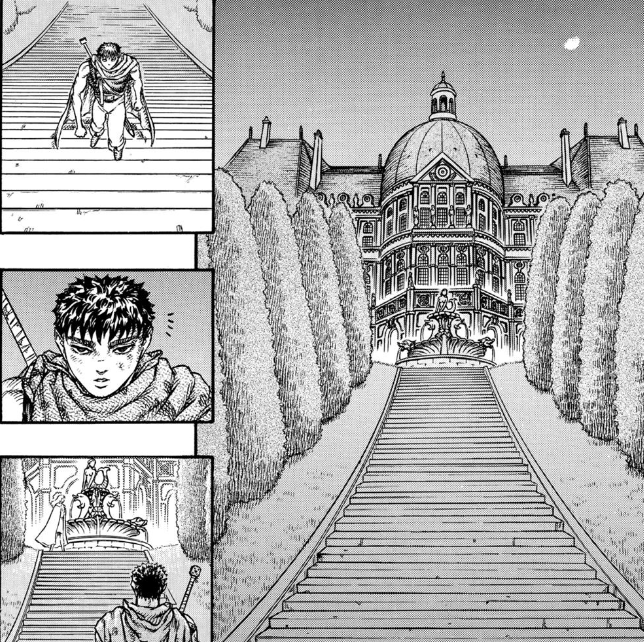
The beginning of the end…
This rattles Guts. He is speechless. At that moment, all other people and objects fade into black. Griffith stands above the stars. Guts is at the bottom of them, helplessly looking upwards at the man who is not his equal. And to emphasize the point, Griffith accedes to Charlotte’s awe by jumping on the railing surrounding the fountain so that he is also physically above her! As he clearly woos the princess, Casca equally checks out of the conversation, turning away to leave the fountain completely. They have both been left behind.
Guts is then plagued with feelings of worthlessness and self-doubt, not quite understanding his place in the world. He just plunged himself into a traumatic situation on behalf of someone else’s dream, quickly learning afterwards that the benefactor of his murder spree doesn’t even acknowledge him as a friend. This conversation is the beginning of the end for their relationship and of the Hawk.
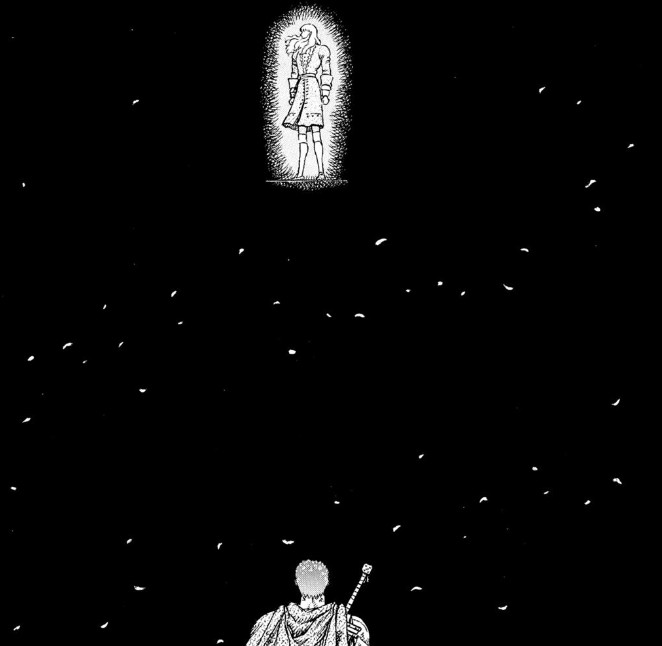
It’s lonely at the bottom.
When Guts finally severs ties with Griffith to find his own Precious Thing, he is once again forced into a battle to win his freedom. The fight ends with Guts defeating Griffith. Their positions are reversed now, in a much more explicit way: Griffith is on the floor, stunned to silence, and Guts looms over him with his sword. Only when their positions change is Guts able to move on and find his own dream.
Berserk is told from the eyes of Guts, and so, even though these are clear examples of Guts consistently languishing in Griffith’s shadow, there are times when Griffith puts himself on the line for Guts. During one of Guts’s first exhibitions as the Raid Captain, Griffith turns back to ensure he’s safe. When Guts goes missing during the first Zodd encounter, Griffith puts himself at risk to help him. He also puts his reputation on the line to ensure both Guts and Casca are assisted after they get separated from the group whilst fighting Adon. And these moments of self-sacrifice plague Griffith during his imprisonment, and are what drive him to sacrifice the Band. He views this behaviour as Guts making him forget his dream.
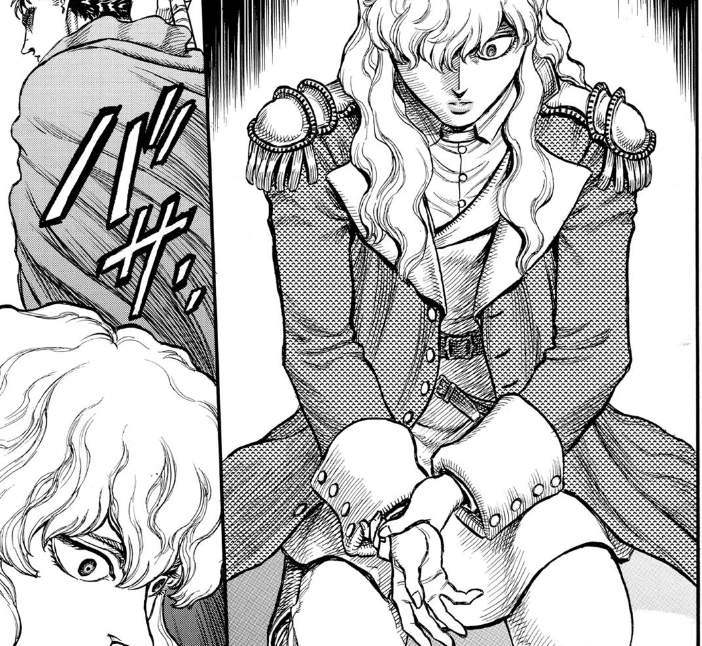
And THAT’S how you clear a bitch!
It’s a shocking admission from someone who readily understands that his own band risks their lives for his dream unquestionably, but the storytelling shows us that Griffith doesn’t see himself like the others. He is above them. That Guts made him forget himself is an unforgiveable sin—on Guts’s part. As his anguish festers, he is locked in a prison in the bottommost part of the entire city for a year, the lowest he has ever been both physically and mentally.
During his final stand against Guts at the Eclipse, Griffith is raised upon an impossibly high platform by the God Hand, above everyone, and just when Guts is finally able to reach him, Griffith is sealed away for ever.
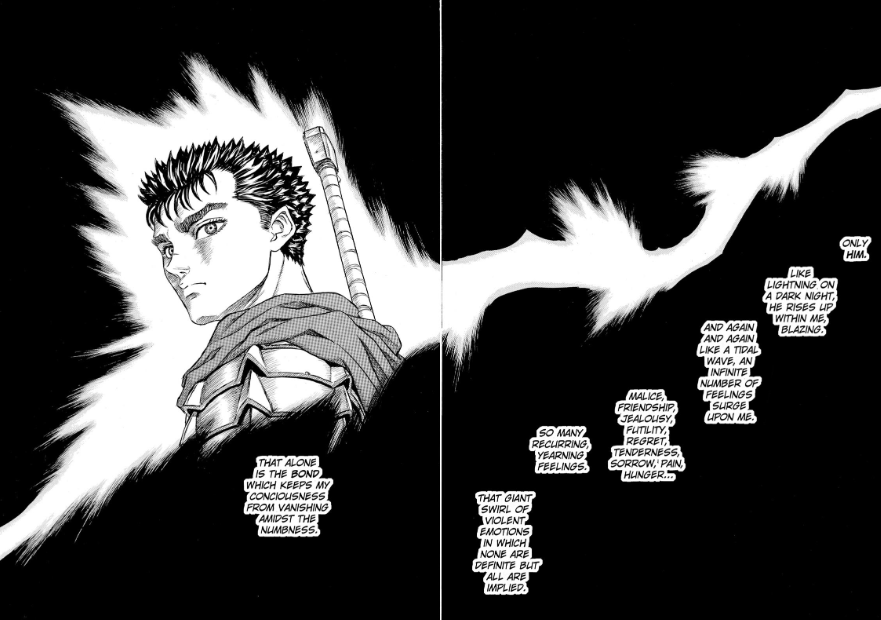
Here is Griffith admitting that Guts is the only thing keeping him alive. And just look how PRETTY his memory of Guts is? I’m dead.
How fitting, then, that Griffith’s request for his new form is something that will ensure he is always, always, above everyone else: wings.
The explosive Chapter 367 was recently released by Studio Gaga, and so far Griffith has the upper hand. He has been given yet another opportunity to remind Guts of their positions in this world. I anxiously await the day when Guts reverses their positions again.